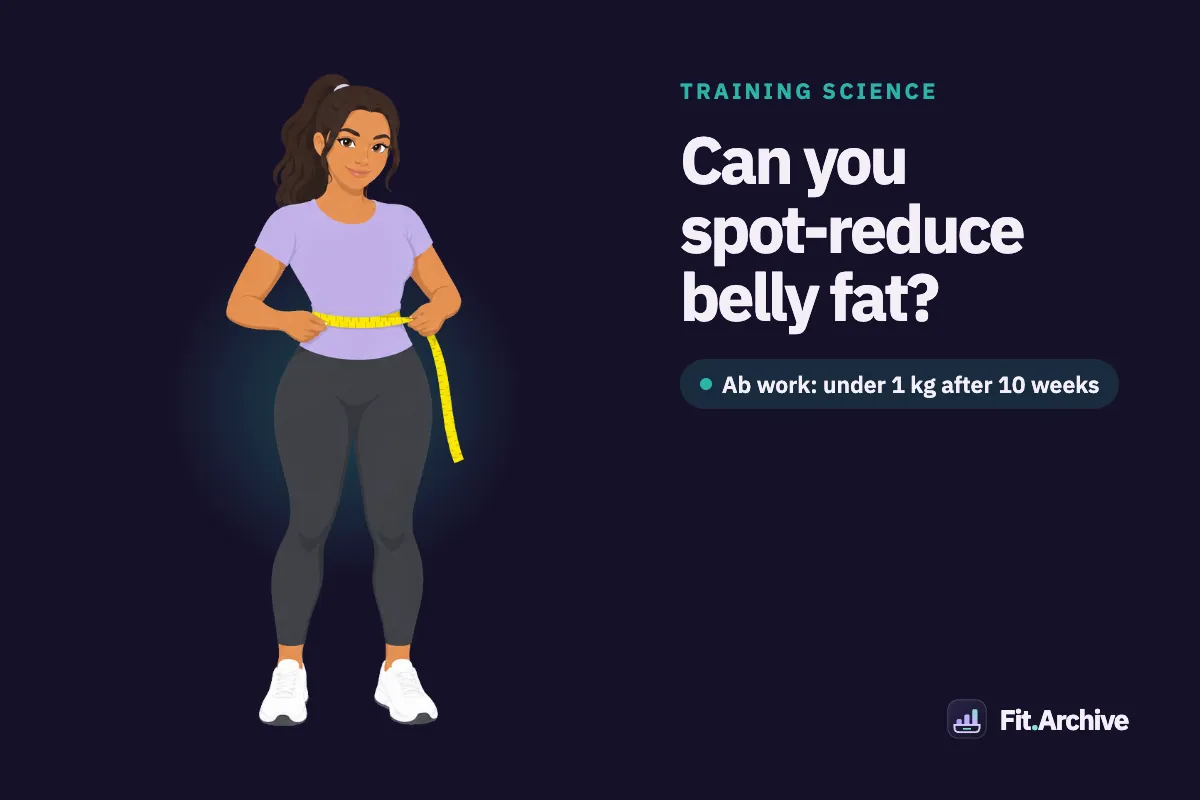
Not in any way you can rely on. Most studies find that ab exercises, even done daily for weeks, do not remove noticeably more fat from the belly than from anywhere else. A few small recent trials report a small local effect, but it is far smaller than the effect of losing fat overall. Belly fat comes down when total body fat comes down, through overall diet, regular training, sleep and time. Ab training is still worth doing: it makes your core stronger, it just does not decide where fat leaves first.
“Do 100 crunches a day for a flat stomach” is one of the most shared fitness ideas on social media. This guide tests that claim against the research, explains why waist size matters for health, and shows how to measure progress without relying on the mirror. It is general information, not medical advice, and it makes no promise about how any body will change. Bodies store and lose fat differently, and that is normal.
Can you spot reduce fat? What the studies show
“Spot reduction” means losing fat from one area by exercising the muscles underneath it. Here are the main human studies:
| Study | Who | What they did | What happened |
|---|---|---|---|
| Vispute et al. 2011 | 24 inactive adults (14 men, 10 women) | 7 ab exercises, 2 sets of 10, 5 days a week for 6 weeks, diet kept the same | No change in belly fat, total body fat, waist or belly skinfolds compared with the control group. Ab endurance improved |
| Kordi et al. 2015 | 40 women with overweight or obesity | Diet alone, or diet plus 12 weeks of ab resistance training | Both groups lost weight, waist size and belly fat; adding ab training made no significant difference |
| Kostek et al. 2007 | 104 adults | 12 weeks of resistance training for one arm only | MRI showed no difference in fat loss between the trained and untrained arm. A skinfold test suggested a local effect in men only |
| Ramírez-Campillo et al. 2013 | 11 young adults | One leg trained 12 weeks with very high-rep leg press | Total fat mass fell about 5%, mainly from the arms and trunk, not from the trained leg |
| Paoli et al. 2021 | 14 volunteers | 8 weeks of circuit training built around local exercises, or standard resistance training | The circuit group lost belly fat measured by skinfold and ultrasound; a very small study |
| Brobakken et al. 2023 | 16 men with overweight | 10 weeks, 4 days a week: running plus about 57 minutes of ab work, or running only, matched for energy use | Trunk fat fell about 0.7 kg more in the ab group; total fat loss was similar |
A lab study adds a possible mechanism. In 10 men exercising one leg, blood flow and fat breakdown were generally higher in the fat next to the working muscle. That fits the idea of a small local effect, but it measured a few hours, not visible change.
How strong is this? Every study is small. The larger and better-measured ones, especially the 104-person MRI study and the two randomized trials of ab training in 2011 and 2015, found no useful local effect. The trials that found one were small, and in the 2023 trial the local difference was under a kilogram after 10 weeks of nearly an hour of ab work, four days a week. Even if a local effect exists, it is too small to replace overall fat loss.
Visceral vs subcutaneous fat: why waist size matters
Belly fat comes in two main kinds. Subcutaneous fat sits under the skin; it is the part you can pinch. Visceral fat sits deeper, around the organs inside the abdomen. Visceral fat is the type most linked to heart and metabolic disease, and it cannot be pinched or seen in a mirror.
A tape measure gives a rough view of both. An international consensus statement concluded that waist circumference adds information to body mass index (BMI) for predicting illness and risk of death, called it a “vital sign” for clinical practice, and said meaningful reductions can come from regular moderate exercise and diet. A WHO expert consultation reviewed waist circumference and waist-hip ratio as predictors of heart disease and diabetes, and noted that cut-off points vary by sex, age and ethnicity. Ask your doctor which reference applies to you rather than comparing yourself with a number online.
Visceral fat responds to exercise, though not specifically to ab exercise:
- A 2012 meta-analysis of 35 trials in adults with overweight or obesity found aerobic exercise reduced visceral fat compared with no exercise, while resistance training alone did not show a significant effect.
- A 2016 meta-analysis of 117 studies found both exercise and diet reduce visceral fat. Without weight loss, exercise was linked to about a 6% drop in visceral fat, while diet showed virtually none. The authors concluded body weight can be a poor marker of these changes.
What actually helps reduce belly fat?
There is no single trick, but these are the parts with evidence behind them:
- Overall diet. Fat loss anywhere depends on eating less energy than you use over time. This article does not set calorie targets; a dietitian can help with yours. Our Vietnamese food calorie table can help you see where your calories come from.
- Resistance training. It helps you keep muscle while you lose fat. See how to keep muscle while cutting.
- Cardio. The visceral fat studies above favour aerobic exercise. Moderate amounts fit alongside lifting; see whether cardio kills gains.
- Sleep. In a small diet study, people sleeping 5.5 hours lost less fat than when they slept 8.5 hours on the same diet. The sleep article covers more.
- Ab training, for what it does. It builds trunk strength and endurance. In the 2011 trial, the ab group managed 47 curl-ups on average after training, against 32 in the control group.
- Time. Fat loss is slow, and the belly is often one of the later places to change.
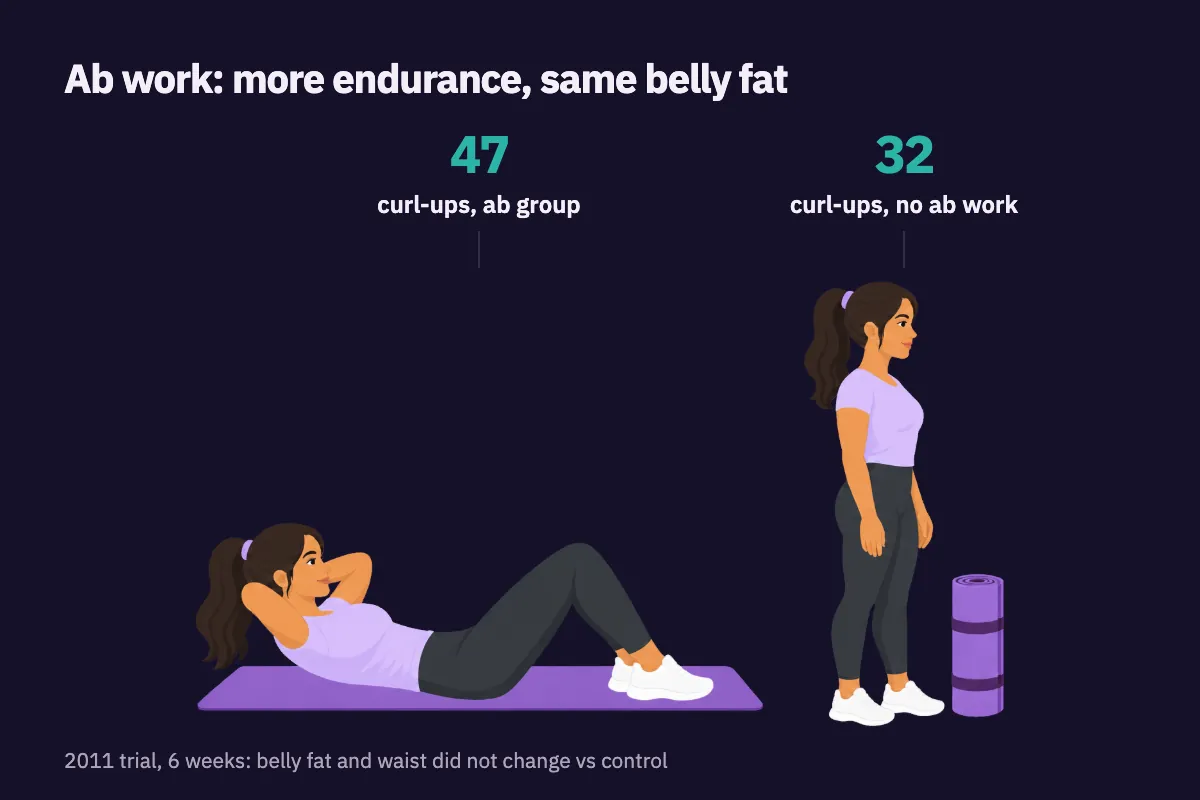
Ab training builds trunk endurance; it does not target belly fat.
If you train at home, the same rules apply: a dumbbell workout at home with progressive loading works the whole body, which is what overall fat loss needs alongside diet.
Why lower belly fat often goes last
Many people find the lower belly is the last area to change, and for many women the hips and thighs too. Where your body stores fat, and the order in which it gives it up, are shaped by sex, age, genes and hormones. No exercise has been shown to change that order. Lower ab exercises such as leg raises train the same muscles as other ab work; they do not target the fat below the navel. If the rest of you is getting leaner and your waist is shrinking, the process is working even if the lower belly lags behind.
Postpartum belly and medical causes: ask a clinician
Some belly changes are not about fat. After pregnancy, the abdominal muscles can separate (diastasis recti), and some ab exercises may not suit you until a clinician or women’s health physiotherapist has checked. Bloating, a bulge that appears when you strain, sudden swelling, or a waist that grows while you are losing weight elsewhere can have medical causes. Hormonal changes around menopause can also shift where fat is stored. In any of these situations, ask a doctor before starting an aggressive ab or diet plan. If you are pregnant, follow your clinician’s advice on exercise.
How to measure belly fat progress
The mirror and photos change with lighting, posture, bloating and mood. A tape measure is cheaper and steadier:
- Measure at the same spot every time. A common method is midway between the lowest rib and the top of the hip bone; measuring at the navel also works if you always use it.
- Same conditions. Morning, before eating, after using the toilet, standing relaxed at the end of a normal breath out.
- Snug, not tight. The tape should be level and should not press into the skin.
- Measure twice and average if the readings differ.
- Every one or two weeks, not daily. Look at the trend over a month.
Pair the waist with your weekly average body weight. This is an invented example, not a predicted result:
| Week | Weekly average weight | Waist |
|---|---|---|
| 1 | 78.4 kg | 92.0 cm |
| 3 | 77.9 kg | 91.5 cm |
| 5 | 77.6 kg | 91.4 cm |
| 7 | 77.0 kg | 90.6 cm |
Week 5 looks like nothing happened, which is common. The trend over seven weeks is what counts.
Common mistakes
- Hundreds of crunches a day expecting the belly to flatten. The trials above found no meaningful fat difference.
- Sweat belts and waist trainers. Sweating loses water, which comes back when you drink.
- Judging from the mirror after one good or bad day.
- Extreme diets that you cannot keep up, or that leave no energy for training.
- Ignoring sleep while focusing only on exercise.
- Comparing your body with someone else’s. Fat distribution differs between people; your own trend is the only fair comparison.
Tracking your waist in FitArchive
FitArchive is a free, private training and food log that works in your browser, including offline; data stays on your device unless you sign in to sync. You can add optional body measurements in centimetres, including waist, chest, arm and hip, and record one body weight reading a day to see a smoothed weight trend with the change per week. Log meals with daily calories and protein, and workouts with weight, reps and RIR for each set. Progress photos are optional and stay on that device. See how the food and training records fit together in logging food and workouts together, or open the demo with sample data.