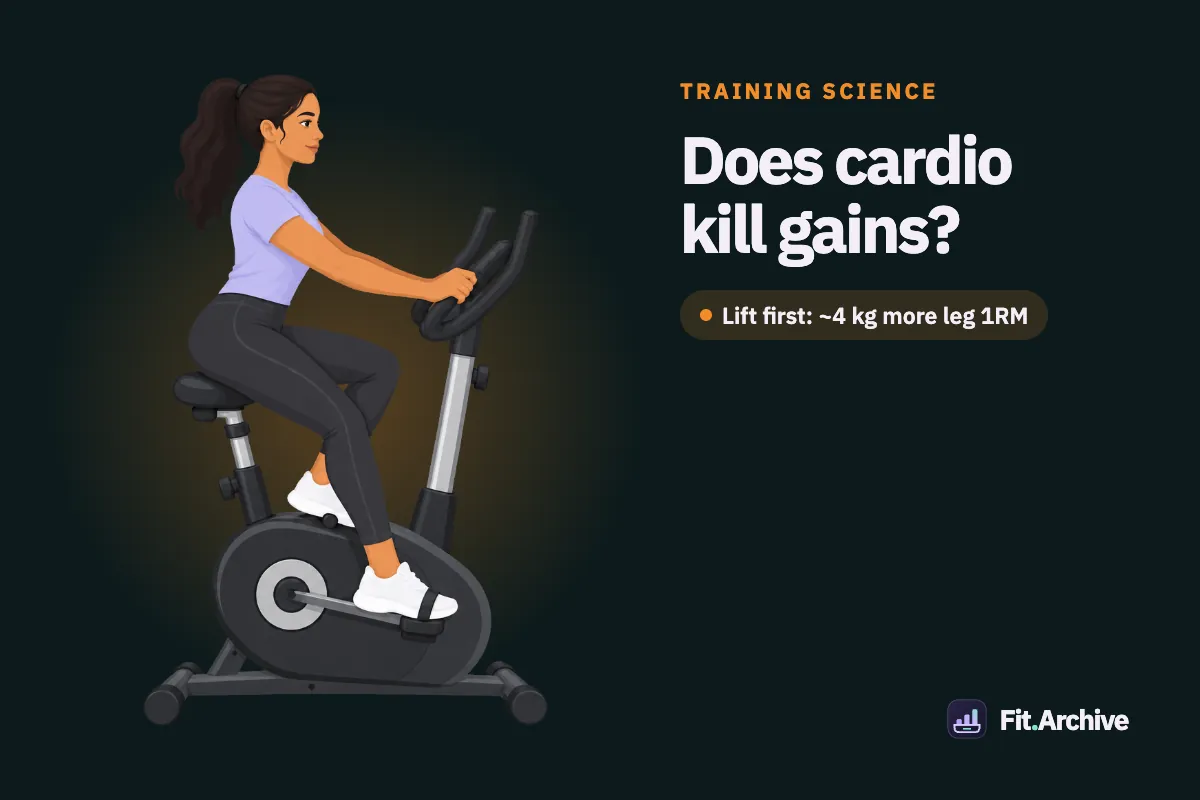
No, for most people cardio does not kill gains. Meta-analyses find that adding a moderate amount of aerobic training to a lifting program does not meaningfully reduce muscle growth or maximal strength on average. The “interference effect” is real but small and specific: it shows up mainly as smaller gains in explosive strength and power, and in lower-body strength for trained lifters, especially with large amounts of cardio, running, or cardio done in the same session as lifting. If both matter to you, keep cardio moderate, lift first or separate the two by a few hours, and check your own log.
“Cardio kills gains” is a popular line on gym TikTok and in forums, usually aimed at anyone who jogs between leg days. This guide tests that claim against the research, shows how strong the evidence is, and explains how to use your training log to see whether cardio is actually holding you back.
What is the interference effect?
The interference effect is the idea that training for endurance and strength at the same time can make strength or muscle gains smaller than strength training alone. It was first described in a 1980 study by Hickson: a group that combined strength training five days a week with endurance training six days a week gained leg strength at the same rate as the strength-only group for seven weeks, then levelled off and declined in weeks 9 and 10.
That study is famous, but it used a very large combined workload. Modern research asks a more useful question: how much interference, for which outcome, under which conditions?
Proposed explanations include fatigue carrying over into lifting sessions, competing signals inside the muscle, and simply less recovery. These mechanisms are still debated, so this article focuses on outcomes you can measure: muscle size, strength and power.
What the research shows
| Study | Size | Main finding |
|---|---|---|
| Wilson et al. 2012, meta-analysis | 21 studies | Concurrent training still built muscle and strength, but less than lifting alone (hypertrophy effect size 0.85 vs 1.23). Running, not cycling, was linked to losses; more frequent and longer cardio meant more interference |
| Murlasits et al. 2018, meta-analysis | Trials of same-session order | Lifting before endurance gave about 4 kg more lower-body 1RM gain; aerobic fitness was not affected by order |
| Sabag et al. 2018, meta-analysis | HIIT plus lifting | Muscle growth and upper-body strength similar to lifting alone; lower-body strength gains slightly smaller |
| Petré et al. 2021, meta-analysis | 27 studies | Lower-body 1RM gains smaller in trained people, not in untrained; the effect appeared only when both were done in the same session |
| Schumann et al. 2022, meta-analysis | 43 studies | No difference for muscle size or maximal strength; explosive strength was reduced, more so in same-session training than with at least 3 hours between |
| Lundberg et al. 2022, meta-analysis | 15 studies | Possible small reduction in muscle fibre growth, mainly in type I fibres when the cardio was running |
| Huiberts et al. 2024, meta-analysis | 59 studies | Small interference for lower-body strength in men, not in women; too little data to judge muscle size |
| Held et al. 2026, umbrella review | 17 meta-analyses, 144 studies | Compared with lifting alone, strength, power and muscle size were comparable, and aerobic fitness was better |
How strong is this evidence? There are many studies, but most are short (often 8 to 12 weeks), use untrained or recreationally active people, and are small. Highly trained lifters and long-term data are scarce. The direction is consistent, though: the average cost to muscle growth is small to none, and the clearest cost is to power and lower-body strength in specific setups.
Running or cycling: which cardio is better for lifters?
Older data favoured cycling. Wilson et al. found interference with running but not cycling, and Lundberg et al. saw the fibre-level effect mainly with running. Proposed reasons include the impact and eccentric loading of running, and the fact that pedalling resembles a leg press movement, but these are explanations, not proven causes.
Newer data are less clear-cut. Schumann et al. found no difference between cycling and running, and Sabag et al. even saw a trend for cycling HIIT to affect lower-body strength more. The honest summary: modality matters less than the amount, and if your legs already feel beaten up from running, cycling, rowing, swimming or brisk walking are reasonable swaps.
How much cardio is fine?
The research does not give a precise safe dose. What it does show:
- Amount matters. Wilson et al. found more frequent and longer cardio sessions linked to more interference.
- Health guidelines are a sensible baseline. The WHO 2020 guidelines recommend 150 to 300 minutes of moderate-intensity or 75 to 150 minutes of vigorous-intensity aerobic activity per week for adults, plus regular muscle-strengthening activity. For example, 150 minutes is five 30-minute sessions or three 50-minute sessions.
- Increase gradually. If you add cardio, add it in steps and watch your lifting numbers rather than starting with a large weekly amount.
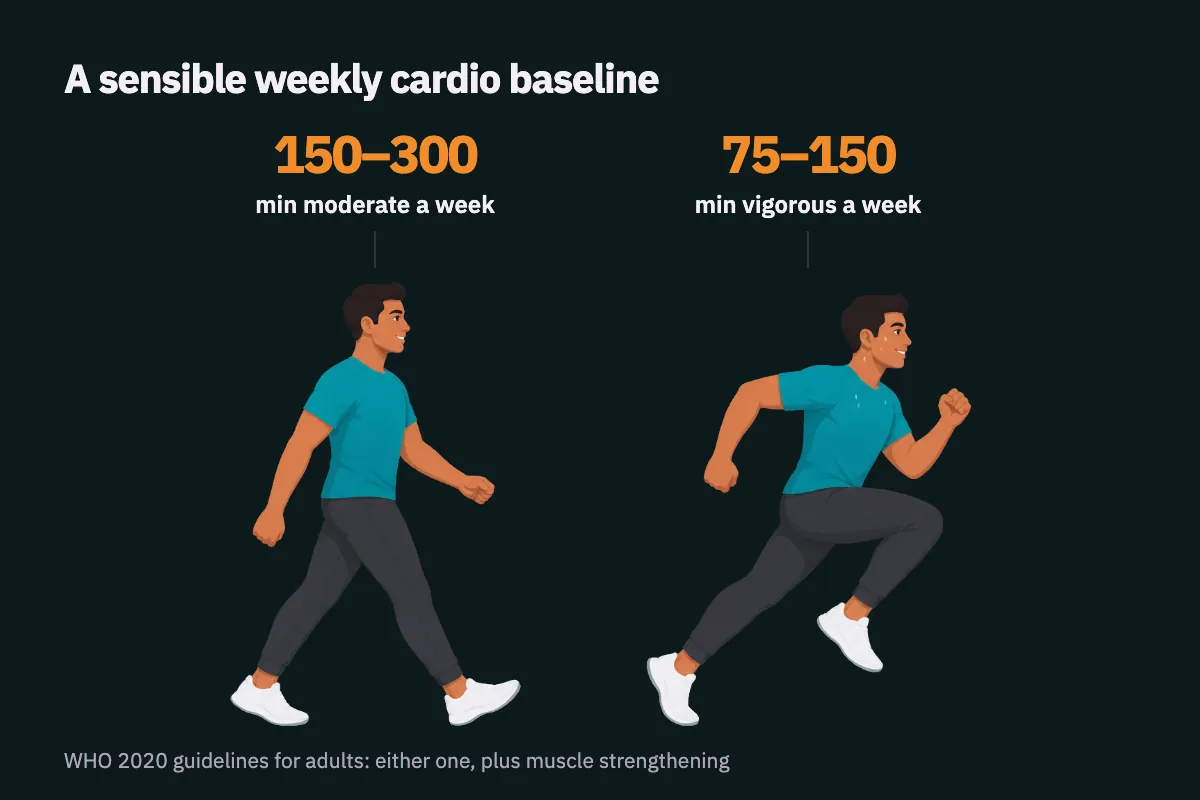
This range is unlikely to cost most lifters noticeable muscle.
For most people lifting for health or appearance, that range is unlikely to cost noticeable muscle. Endurance athletes and powerlifters with high volumes of both face a different trade-off and benefit from individual programming.
Should you do cardio before or after weights?
If your priority is strength, lift first. Murlasits et al. found that lifting before endurance work produced larger lower-body strength gains, while aerobic fitness improved either way. Held et al. found no significant effect of order across meta-analyses, only a trend favouring lifting first, so the effect is modest.
Better still, separate them when you can. Schumann et al. found explosive strength was blunted more when both were done in one session than with at least 3 hours between them, and Petré et al. saw the strength cost in trained people only in same-session designs. Practical options:
- Cardio on non-lifting days.
- Lifting in the morning, cardio in the evening, or the reverse.
- If both must share a session, a short easy warm-up on the bike is fine; save long or hard cardio for after lifting.
- Keep hard intervals away from the day before heavy leg sessions.
Can you do cardio while cutting?
Yes. Cardio adds to the energy you spend, which can help create a calorie deficit alongside food. How much fat you lose depends on your overall energy balance, not on cardio alone, and results vary. During a cut, the lifting itself and enough protein matter most for keeping muscle; see how much protein per day and body recomposition, bulking and cutting.
Low-impact cardio such as walking or cycling is easier to recover from when food is lower. Watch your lifting performance; if it drops steadily, the deficit or the cardio may be too much.
Why lifters should not skip cardio
Aerobic activity is linked to better heart and metabolic health, and the WHO recommends both aerobic and muscle-strengthening activity for that reason. For lifting, better aerobic fitness can help you recover between hard sets and handle longer sessions; Held et al. found combined training improved aerobic capacity compared with lifting alone. If you have a heart, lung or metabolic condition, get chest pain or dizziness when exercising, are pregnant, or are under 18, ask a clinician what amount suits you first. This article is general information, not medical advice.
How to log cardio so you can spot real interference
Cardio only “kills gains” for you if your lifting numbers say so. Track both:
- Note each cardio session in your workout notes: type, minutes, how hard it felt, and how many hours before or after lifting.
- Pick a lifting marker per lower-body lift, such as reps at a fixed load or an estimated 1RM, and log RIR so sets are comparable.
- Compare blocks with more and less cardio, over several weeks, not single sessions.
An example log, invented for illustration:
| Week | Cardio that week | Squat 100 kg, reps at about 2 RIR | Note |
|---|---|---|---|
| 1 | 2 × 30 min cycling, rest days | 6 | Baseline |
| 2 | 2 × 30 min cycling, rest days | 7 | Progressing |
| 3 | 4 × 40 min running, two right before legs | 5 | Legs heavy |
| 4 | 3 × 30 min cycling, rest days | 7 | Back on track |
Week 3 suggests same-day running before legs cost reps. One week is not proof; sleep or stress could explain it. But if the pattern repeats, you have found your own interference and can adjust. For a fuller check of stalled lifts, use the plateau audit.
Common mistakes
- Dropping cardio entirely out of fear. The average cost to muscle is small, and the health benefits are real.
- Adding a lot at once. A sudden jump to daily long runs is closer to the 1980 study than to most people’s training.
- Hard intervals right before heavy legs. That is the setup most likely to cost strength.
- Blaming cardio for everything. A calorie deficit, poor sleep or less lifting can all look like interference.
- Not writing it down. Without cardio in your log, you cannot connect it to lifting performance.
Logging lifting and cardio in FitArchive
FitArchive is a free training log for lifting: you record each set’s weight, reps and RIR, and the Progress screen shows estimated 1RM per exercise and weekly hard sets by muscle. It does not track cardio sessions as their own entries, so write cardio in the workout notes (for example, “30 min cycling, easy, 3 h after lifting”) and compare your lifting numbers across weeks. If you import history from Strong or Hevy, the preview lists timed or distance sets that cannot be imported yet. You can try the layout with sample data in the demo.