RPE and RIR describe the same lifting set from opposite directions. RIR (reps in reserve) is your estimate of how many more good reps you could have done; the lifting RPE scale rates the set from 1 to 10, where 10 means no rep was left. On that scale, RPE ≈ 10 − RIR, so RPE 8 is about 2 RIR. Pick one, define it, and log it the same way every set.
What is RPE in lifting?
RPE stands for rating of perceived exertion. The original Borg scale ran from 6 to 20 and was used mainly for aerobic exercise; Borg’s later CR10 scale moved to a 10-point range (Borg, 1982). Coaches also use session RPE, a single rating for a whole workout given after it ends (Foster et al., 2001). Those scales measure general effort. None of them is the number most lifting programs mean by “RPE 8”.
The lifting version is the RIR-based RPE scale tested by Zourdos et al. (2016), where RPE 10 means 0 reps in reserve, RPE 9 means 1, and so on. A practical review by Helms and colleagues explains why the reps-left anchor was added: with traditional RPE scales, lifters often gave less-than-maximal scores even on sets where they could not do another rep. The same review notes that the scale uses rep-based descriptions at the hard end, groups 5–6 as “4–6 reps left” because people find a range easier when several reps remain, and describes the lowest scores by effort rather than reps.
What is RIR?
RIR is a count, not a feeling: how many more repetitions could I have completed with the technique I count as a good rep? A set of 10 that you think could have gone to 12 is 2 RIR. The answer depends on your technique standard, so decide what “good rep” means before you start. Stopping because form would break down is not always the same as reaching momentary muscular failure; our training to failure vs RIR guide covers that difference. For a step-by-step method, see how to log RIR for every set.
RPE to RIR conversion chart
On the lifting-specific scale, the conversion is a reading of the same estimate, not a calculation of what you would actually have achieved.
| Lifting RPE | Approximate RIR | What the set felt like |
|---|---|---|
| 10 | 0 | Another good rep did not seem possible |
| 9 | 1 | One good rep probably left |
| 8 | 2 | Two good reps probably left |
| 7 | 3 | Three good reps probably left |
| 5–6 | 4–6 | Several reps left; a range is more honest than a single number |
| 1–4 | Not rep-based | Light to very light; rated by effort, not reps left |
Some programs use half-points such as 8.5, which sits between one and two reps left. If your log stores whole numbers, decide once how you will round half-points and keep that rule.
What does RPE 8 mean?
RPE 8 means you finished the set believing you had about two good reps left, the same as 2 RIR. It does not mean the set felt “80% hard” or that you used 80% of your one-rep max. Load and effort are separate fields: 60 kg × 8 at RPE 8 and 60 kg × 5 at RPE 8 are very different sets.
Worked example: the same three sets, logged both ways
These numbers are an invented example for one lifter’s bench press, not results or a recommended plan.
| Set | Load × reps | Logged as RPE | Logged as RIR | Note |
|---|---|---|---|---|
| 1 | 60 kg × 8 | 7 | 3 | Bar speed steady |
| 2 | 60 kg × 8 | 8 | 2 | Last rep slower |
| 3 | 60 kg × 7 | 9 | 1 | Rest was 90 s instead of 2 min |
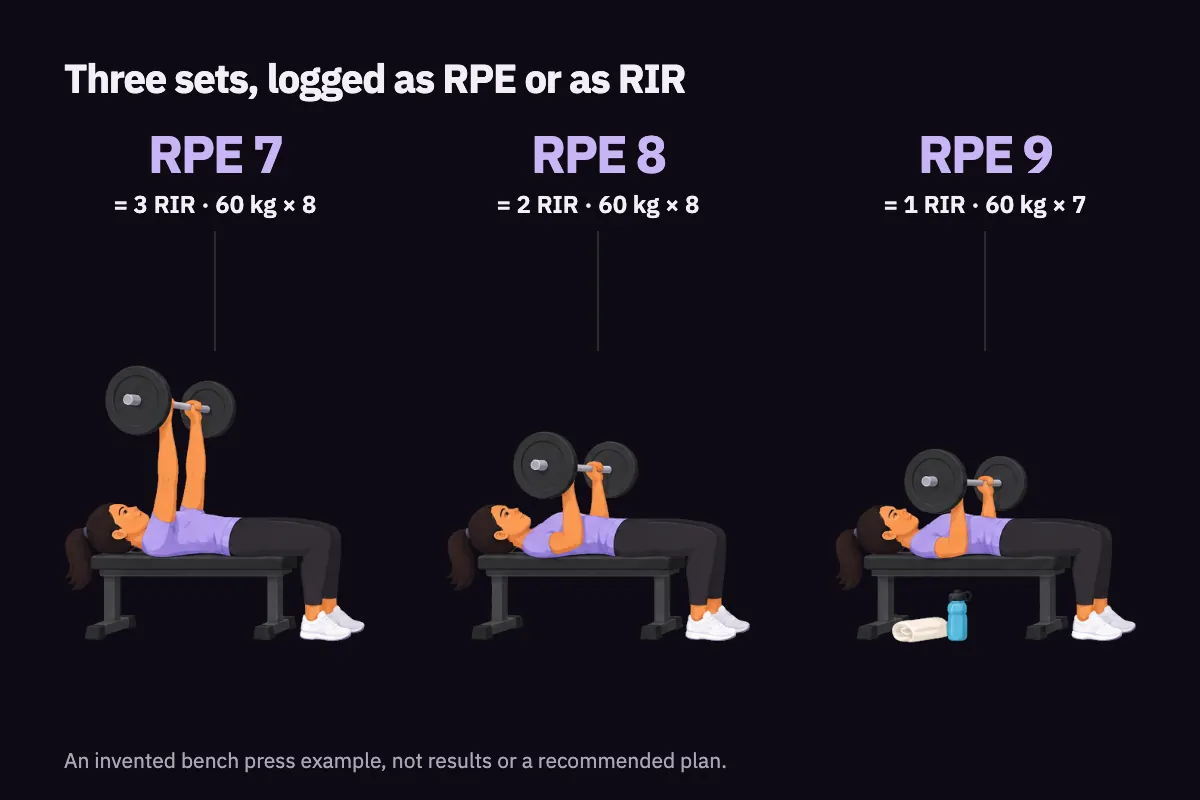
Either column tells the same story, so log just one.
Either column tells the same story: effort rose across sets and set 3 lost a rep. Logging both adds typing without adding information, because one column is derived from the other. The note matters more than the scale here: shorter rest probably explains the missing rep, as our rest between sets guide explains.
Is RPE the same as RIR?
For ordinary rep-based sets close to failure, the two are designed to line up. They can drift apart when:
- The RPE is not the lifting scale. A session RPE, a cardio rating or a Borg 6–20 score cannot be converted with 10 − RIR.
- The set is far from failure. At 5 or more reps left, both numbers become a rough range.
- There is no rep to count. Timed holds, carries and conditioning work suit a perceived-effort rating better than a reps-left count.
- “How hard it felt” is not “how many reps were left”. A long, burning high-rep set can feel brutal while you still have reps in reserve. RPE invites you to rate the feeling; RIR asks only for the count.
How accurate are RPE and RIR estimates?
Both are estimates, and research suggests they are imperfect. A scoping review and meta-analysis by Halperin et al. (2022), pooling 12 studies with 414 participants, found people underpredicted how many reps they had left by about one rep on average, with wide variation between studies. Predictions were somewhat more accurate closer to failure, in sets of 12 or fewer reps and in later sets; training status did not appear to change accuracy in that analysis. In the Zourdos study, experienced squatters rated a true one-rep max higher than novices did, a reminder that a 10 from a beginner may not mean the same as a 10 from a veteran.
Practical takeaways:
- Treat 0–3 RIR as a usable estimate and anything above that as a range.
- Expect your accuracy to vary by exercise and rep range.
- Rate after the last rep, not halfway through, and compare like with like: the same exercise, a similar rep range, similar rest.
RPE or RIR: which should you log?
Choose RIR if “how many good reps were left?” is easy for you to answer and you mainly want to compare similar working sets. It also plugs neatly into rules such as double progression, where you add load once you hit the top of a rep range at a set effort.
Keep lifting RPE if your coach or program already prescribes it, as many strength programs do. Rewriting a program into another scale is an easy place to make mistakes.
Whichever you pick, log one number per working set, alongside the exercise and variation, load and unit, and completed reps. Our strength workout log template shows a layout with one effort column.
Common mistakes
- Mixing scales without a note. If your old log used RPE and your new one uses RIR, record the switch date. Do not splice converted values into one chart as if they were measured the same way.
- Using session RPE as set RPE. A whole-workout score of 7 says nothing about how close a single set came to failure.
- Logging the planned number. If the plan said RPE 8 and the set was really a 9.5, write what happened.
- Rating warm-ups. Effort numbers far from failure are the least reliable; keep warm-ups marked separately.
- Changing your technique standard silently. A deeper squat or a pause on the chest changes how many good reps are left. Add a note.
- Treating the scale as permission to grind through pain. Effort ratings describe fatigue, not injury. Stop the set if something hurts and seek appropriate professional advice for persistent symptoms.
Logging effort in FitArchive
FitArchive records RIR per set rather than RPE. If you import a Strong or Hevy CSV export, RPE values are converted to whole-number RIR using 10 − RPE. The sample-data demo lets you look at the layout before entering your own training.