Yes, you can build muscle with bodyweight exercises at home, as long as two things are true: your sets end close to failure, roughly 0 to 2 reps in reserve (RIR), and you keep moving to harder variations as you get stronger. Push-ups, split squats and single-leg bridges cover the chest, shoulders, triceps, legs and glutes with no equipment. The real gap is your back: without a bar or a band there is no good way to load pulling, so a pull-up bar or a resistance band is the first thing worth buying.
Below: the research, progression ladders, the pulling problem, two example plans and how to log bodyweight sets so progress stays readable.
Can you build muscle with bodyweight exercises?
The direct evidence is small, but it points the same way as the research on light loads:
- In an 8 week study by Kikuchi and Nakazato, 18 young men did 3 sets to failure twice a week of either bench press at 40% of their one-rep max or push-ups adjusted (for example, from the knees) to a similar load. Chest and triceps thickness and bench press strength increased similarly in both groups.
- In a 4 week trial by Kotarsky and colleagues, 23 moderately trained men did either bench press or progressively harder push-up variations three times a week. Bench press strength rose in both groups. Muscle thickness did not change significantly in either group over such a short study.
- A 2017 meta-analysis of 21 studies found light loads (60% of one-rep max or less) and heavy loads built similar muscle when all sets went to failure, while heavy loads built more maximal strength.
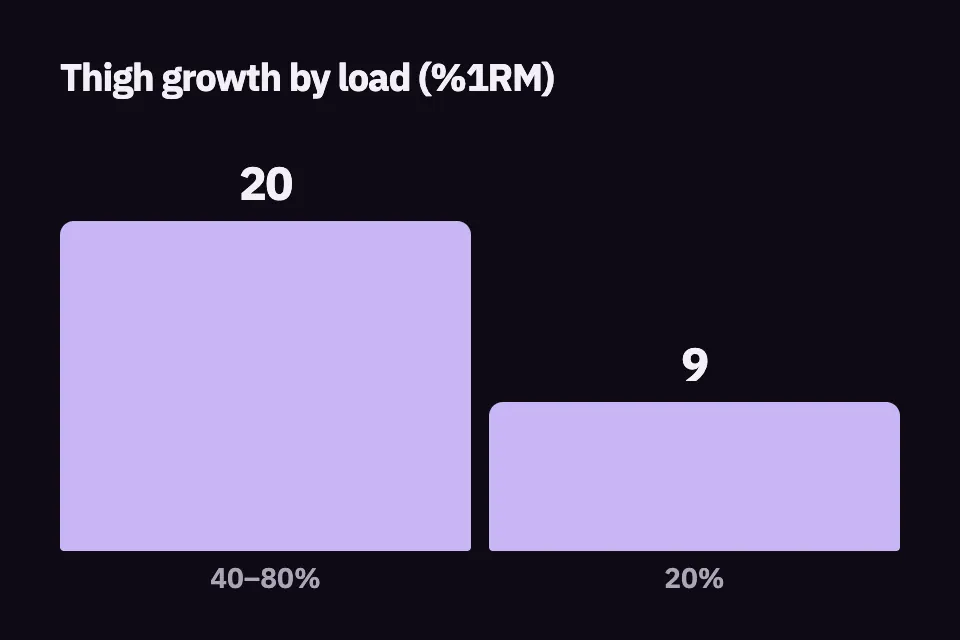
Effort is the catch. In a study of 25 untrained men, sets at 30% of one-rep max taken to failure (about 34 reps) grew the quadriceps about as much as heavy sets, but the same light load stopped well short of failure (about 20 reps) produced no clear growth. Heavy sets worked either way. Most bodyweight exercises are light loads, so an easy set of 15 does much less than you think.
The 2026 ACSM position stand, an overview of 137 systematic reviews, found that about 10 or more sets per muscle each week enhanced muscle growth and that equipment type did not consistently change outcomes. Training to failure did not consistently matter either, which fits the study above: closeness to failure matters most with light loads, like bodyweight. More in how many reps build muscle.
The evidence is encouraging but limited: two small, short push-up studies, light load research done mostly with young men, and few studies of whole bodyweight programs.
Bodyweight progression ladders
You cannot add 2.5 kg to a push-up, so you make exercises harder by changing leverage, using one limb or adding range. Each rung maps to an exercise in FitArchive’s library.
| Pattern | Rung 1 | Rung 2 | Rung 3 | Rung 4 |
|---|---|---|---|---|
| Push (chest, triceps) | Incline push-up, hands on a sturdy table | Push-up | Decline push-up, feet on a stable chair | Push-up with a loaded backpack |
| Push (shoulders) | Pike push-up, feet on the floor | Pike push-up, feet raised | Handstand push-up against a wall (advanced) | |
| Squat (quads, glutes) | Bodyweight squat | Split squat | Bulgarian split squat, rear foot on a stable chair | Pistol squat, first down to a chair, then full |
| Hip (glutes, hamstrings) | Glute bridge | Single-leg glute bridge | Single-leg hip thrust, shoulders on a sofa | Single-leg hip thrust with a pause at the top |
An example rule: stay on a rung while you can do roughly 6 to 20 controlled reps at 1 to 2 RIR, and move up once you reach about 20 to 25. Very long sets can still work if they end near failure, but they are hard to judge: a meta-analysis of rep predictions found people predicted their remaining reps less accurately in sets above 12 reps.
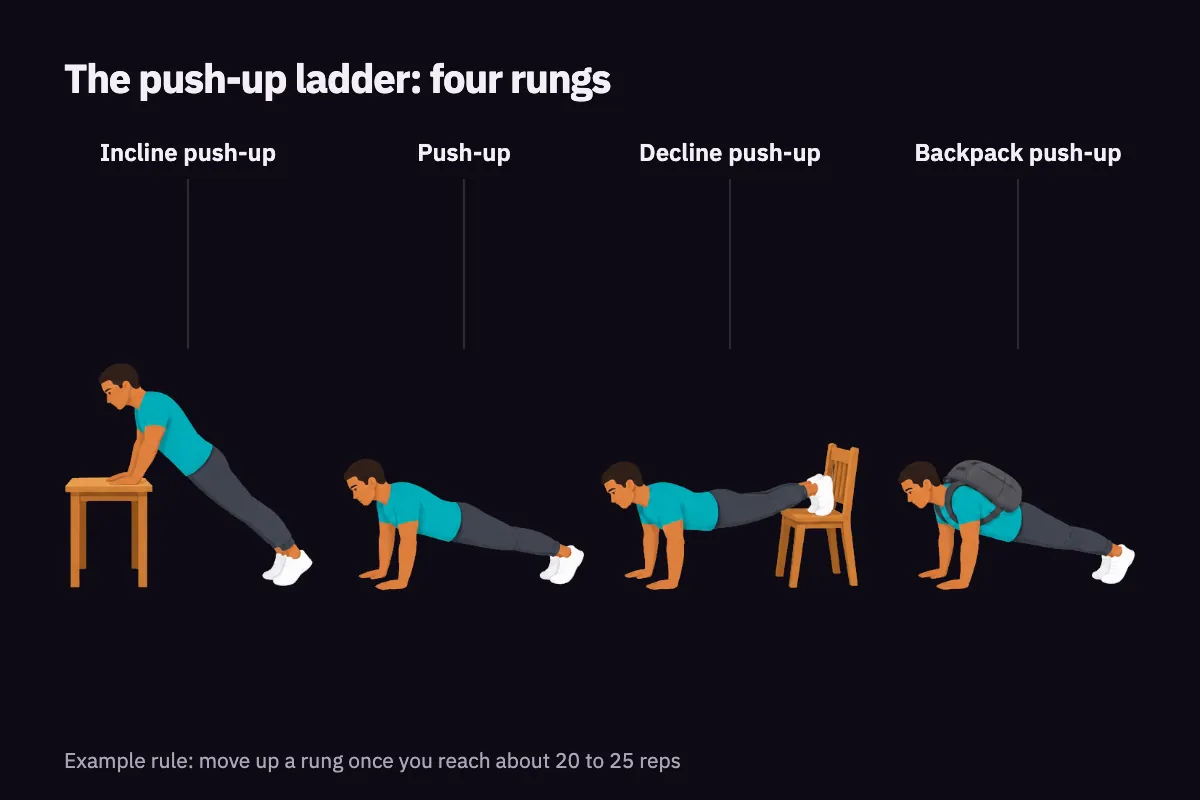
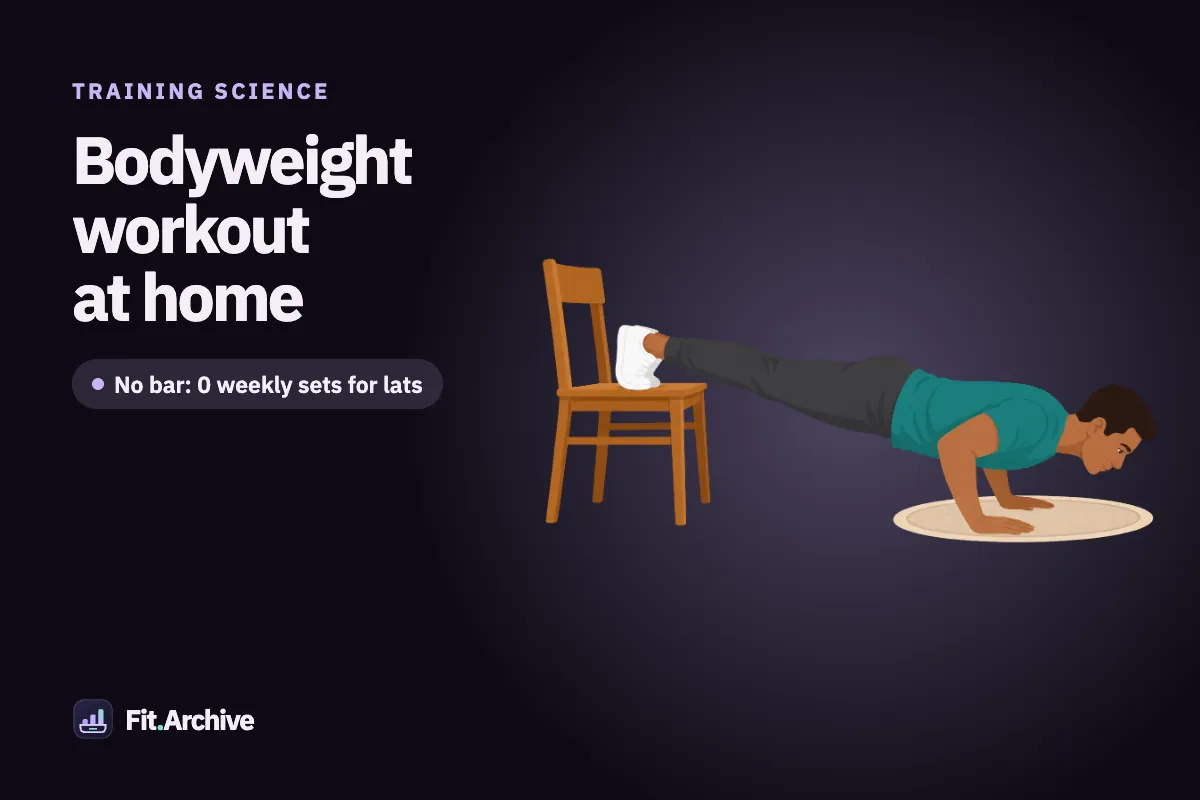
With no plates to add, leverage makes push-ups harder.
Within a rung, add reps (an 8 week trial in 43 trained people found adding reps built similar leg muscle to adding load), slow the lowering phase, pause at the bottom or use a deeper range. Double progression gives a simple rule: reach the top of the rep range on every set, then move up.
The pulling problem at home
Rows and pull-ups train the lats, upper back and biceps, and there is no true no-equipment version.
| What you have | Pulling options (FitArchive library names where they exist) |
|---|---|
| Nothing | Superman for the lower back; reverse snow angels and prone Y raises (lying face down, arms in a Y) for the upper back and rear shoulders, which you can add as custom exercises. These are light and do not replace rows. |
| A solid door | Towel door row, only if the door, hinges and handle are secure (see below). Otherwise skip it. |
| A resistance band | Band row, band pull-apart, band face pull, band-assisted pull-up |
| A doorway pull-up bar | Pull-up, chin-up, neutral-grip pull-up |
Towel door rows (a towel looped around both handles of an open door, feet either side of the edge, leaning back and rowing) are only for a solid door with firmly fixed handles that cannot swing shut or come off its hinges. Test with most of your weight on your feet. If in doubt, skip it: a broken handle means falling backwards.
If back size or pulling strength matters to you, buy a pull-up bar or a resistance band first. Check that a doorway bar fits your frame and its weight limit, and anchor a band only to something that cannot move. The dumbbell workout at home guide covers the next step up.
Example 3 day full body bodyweight workout
This example plan suits beginners and anyone training on three alternate days. Sets × reps, target RIR in brackets. Use the rung that keeps you in the rep range; beginners often start one or two rungs lower. “Per leg” means each side.
| Day | Exercises (sets × reps, target RIR) |
|---|---|
| Full body A | Bulgarian split squat 3 × 8 to 15 per leg (1 to 2), push-up 3 × 6 to 20 (1), superman 3 × 10 to 15 (1), single-leg glute bridge 3 × 10 to 20 per leg (1), pike push-up 2 × 6 to 15 (2), bodyweight calf raise 2 × 15 to 25 (1) |
| Full body B | Reverse lunge 3 × 10 to 15 per leg (1), decline push-up 3 × 6 to 15 (1), superman 3 × 10 to 15 (1), single-leg hip thrust 3 × 10 to 20 per leg (1), diamond push-up 2 × 6 to 15 (1), dead bug 2 × 8 to 12 per side (2) |
| Full body C | Split squat 3 × 10 to 20 per leg (1), push-up 3 × 6 to 20 (1), superman 3 × 10 to 15 (1), single-leg glute bridge 3 × 10 to 20 per leg (1), pike push-up 2 × 6 to 15 (2), bodyweight calf raise 2 × 15 to 25 (1), reverse crunch 2 × 10 to 15 (2) |
That is 50 working sets a week. Counted with FitArchive’s rule (1 set per primary muscle, 0.5 per secondary muscle), that gives about 10 sets for chest, 9 for quads and lower back, 8.5 for front delts and triceps, and 0 for lats, upper back and biceps. That zero is the pulling problem in numbers. With a band or bar, swap each superman for 3 sets of band rows or pull-ups.
Example 4 day upper/lower bodyweight plan
A typical week is Upper A, Lower A, rest, Upper B, Lower B, rest, rest. This example plan assumes you can already do 10 push-ups and Bulgarian split squats per leg. The upper/lower guide explains the split.
| Day | Exercises (sets × reps, target RIR) |
|---|---|
| Upper A | Push-up or decline push-up 4 × 6 to 20 (1), pull slot 4 sets (1), pike push-up 3 × 6 to 15 (2), diamond push-up 2 × 6 to 15 (1), dead bug 2 × 8 to 12 per side (2) |
| Lower A | Bulgarian split squat 4 × 8 to 15 per leg (1), single-leg glute bridge 3 × 10 to 20 per leg (1), Cossack squat 2 × 6 to 12 per side (2), bodyweight calf raise 3 × 15 to 25 (1) |
| Upper B | Decline push-up 4 × 6 to 15 (1), pull slot 4 sets (1), pike push-up with feet raised 3 × 5 to 12 (2), incline push-up 2 × 15 to 25 (0 to 1), superman 2 × 10 to 15 (1) |
| Lower B | Pistol squat to a chair 3 × 4 to 10 per leg (2), reverse lunge 3 × 10 to 15 per leg (1), single-leg hip thrust 3 × 10 to 20 per leg (1), bodyweight calf raise 3 × 15 to 25 (1), reverse crunch 2 × 10 to 15 (2) |
Pull slot: pull-ups or chin-ups for 3 to 10 reps with a bar (band-assisted pull-ups if you cannot do 3 yet), band rows for 10 to 20 reps with a band, otherwise superman. Comparing splits? See push/pull/legs vs upper/lower vs full body.
How to log bodyweight exercises
Make these decisions once and keep them:
- Enter 0 kg for unloaded sets, or the added weight if you wear a loaded backpack. FitArchive records reps and RIR for each set.
- Log each rung as its own exercise. Incline push-up, push-up, decline push-up and pike push-up are separate library entries, so moving up a rung does not look like a drop in reps. The split squat is listed as “Dumbbell split squat”; log it with 0 kg.
- Write variations without their own entry in the workout notes, for example “pistol to a chair, 45 cm” or “pike, feet on chair”, so you compare like with like later.
- Record RIR honestly. With light loads, how close you got to failure is the main training variable. See how to log RIR.
FitArchive’s estimated one-rep max needs a load, so at 0 kg it shows no estimate. With a backpack, it uses only the added kilograms, not your bodyweight, and only when reps plus RIR come to 15 or less, so treat it as a trend for that loaded variation, not a real one-rep max. Judge progress by reps at the same rung and by moving up rungs. Your sets still count toward weekly hard sets by muscle, which uses sets at 0 to 4 RIR regardless of weight; see counting weekly sets.
Common mistakes
- Stopping sets early. Fifteen easy push-ups with ten more in the tank is mostly warm-up. Aim for 0 to 2 RIR.
- Staying on one rung for months. Fifty push-ups a set is an endurance test.
- Skipping the back. If your plan has no rows or pull-ups, note the gap and plan a bar or band.
- Cutting the range to inflate reps. Keep the depth of push-ups and split squats consistent.
- Using unstable furniture. Chairs must not slide or tip; set them against a wall.
Stop any exercise that causes sharp or worsening pain and ask a qualified professional. This is general information, not individual medical advice.
Logging bodyweight workouts in FitArchive
FitArchive is a free training log that runs in your browser, works offline and keeps your data on your device unless you sign in to sync. Its exercise library includes every exercise in the plans above. Start from the Full body 3 days or Upper/Lower 4 days template and swap in the bodyweight exercises, or build your own plan. Log 0 kg or your added weight, reps and RIR for each set, and use workout notes for the exact variation. You can try the layout with sample data in the demo.