Compound (multi-joint) exercises such as squats, presses, rows and pull-ups train several muscles at once, so they give you the most strength and training volume per minute. Isolation (single-joint) exercises such as curls, lateral raises and leg curls train one muscle more directly. Research suggests you do not strictly need isolation work to grow, especially as a beginner, but it is a cheap way to fill gaps: muscles the big lifts train only lightly, or barely at all. The useful question is not which type is better, but whether every muscle you care about gets enough hard sets each week.
What is the difference between compound and isolation exercises?
A compound exercise moves two or more joints. A bench press moves the shoulder and the elbow, so the chest, front delts and triceps all work. An isolation exercise moves one joint: a biceps curl only bends the elbow, a leg extension only straightens the knee.
| Type | Examples | Main strengths | Main limits |
|---|---|---|---|
| Compound (multi-joint) | Squat, deadlift, bench press, overhead press, row, pull-up, leg press | Heavy loads, several muscles per set, direct practice for big-lift strength | Some muscles get only partial work; technique and fatigue limit how many hard sets you can do |
| Isolation (single-joint) | Biceps curl, triceps pushdown, lateral raise, leg extension, leg curl, calf raise | Direct work for one muscle, easy to learn, low overall fatigue, easy to add a set | Lighter loads, one muscle per set, little carryover to big-lift strength |
The line is not perfectly sharp. A Romanian deadlift is mostly a hip movement but is still counted as compound. The labels are handy shorthand, not a category that predicts results on its own.
The popular claim: “compounds are all you need”
On social media you will find two confident camps. One says the big lifts build everything and isolation work is a waste of time. The other says curls and raises are what really build arms and shoulders. Both contain some truth, and the trials show where each one goes too far.
What the studies show
| Study | Who and how long | What was compared | Main finding |
|---|---|---|---|
| Gentil et al. 2013 | 29 untrained young men, 10 weeks | Lat pulldown and bench press, with or without added curls and triceps extensions | Elbow flexor thickness grew similarly (6.5% vs 7.0%); strength gains also similar |
| de França et al. 2015 | 20 men with at least 2 years of training, 8 weeks | Multi-joint only vs multi-joint plus arm isolation | No significant difference in arm strength or arm size measures |
| Gentil et al. 2015 | 29 untrained young men, 10 weeks | Lat pulldowns only vs biceps curls only | Similar elbow flexor growth (6.1% vs 5.8%) and strength |
| Mannarino et al. 2021 | 10 untrained men, 8 weeks, one exercise per arm | Dumbbell row vs biceps curl | The curl arm grew about twice as much (11.1% vs 5.2% elbow flexor thickness); each arm got stronger mainly at its own exercise |
| Brandão et al. 2020 | 43 young men | Bench press, lying triceps extension, or both in either order | Bench alone did not significantly grow the triceps; the extension grew the triceps long head more, the bench grew the chest more |
| Paoli et al. 2017 | 36 physically active men, 8 weeks | Only multi-joint vs only single-joint, same total load lifted | The multi-joint group gained more strength and aerobic fitness; body composition changes were similar |
| Kubo et al. 2019 | 17 men, 10 weeks of squats twice a week | Full vs half squats | Knee extensors, adductors and glutes grew; the rectus femoris and hamstrings did not change in either group |
| Zabaleta-Korta et al. 2021 | Two randomized groups, equal volume | Smith machine squat vs leg extension | Leg extensions grew all three measured regions of the rectus femoris; squats grew only the middle region of the vastus lateralis |
How strong is this evidence? Modest. The trials were small (10 to 43 people), lasted 8 to 10 weeks, and most participants were young men new to lifting. Only one recruited experienced lifters, and only 20 of them. Several measured only the arms. None of the papers in the table is retracted; several other trials on adding single-joint exercises, from one research group, have been retracted, so they are left out here.
The broadest view comes from the 2026 ACSM position stand, which pooled 137 systematic reviews and found that exercise complexity did not consistently change training outcomes. In other words, the exercise type matters less than whether each muscle gets enough hard work.
So, do you need isolation exercises?
Read together, the studies say:
- For beginners, compounds cover a lot. In untrained men, pulldowns grew the biceps about as well as curls, and adding arm isolation to pulldowns and bench presses added little over 10 weeks.
- Compounds win on strength and time. At equal total load, the multi-joint program built more strength. You also train several muscles per set, which is why a review on time-efficient training recommends building sessions around multi-joint exercises, with at least one leg press or squat pattern, one upper-body pull and one upper-body push.
- Some muscles are under-trained by compounds. Squats did not grow the hamstrings or the rectus femoris. The bench press did not clearly grow the triceps long head. Side delts only get indirect work from presses.
- Isolation may matter more when you chase a specific muscle. The one direct comparison favouring curls was small and in beginners, but the regional growth studies agree that exercise choice changes which parts of a muscle grow.
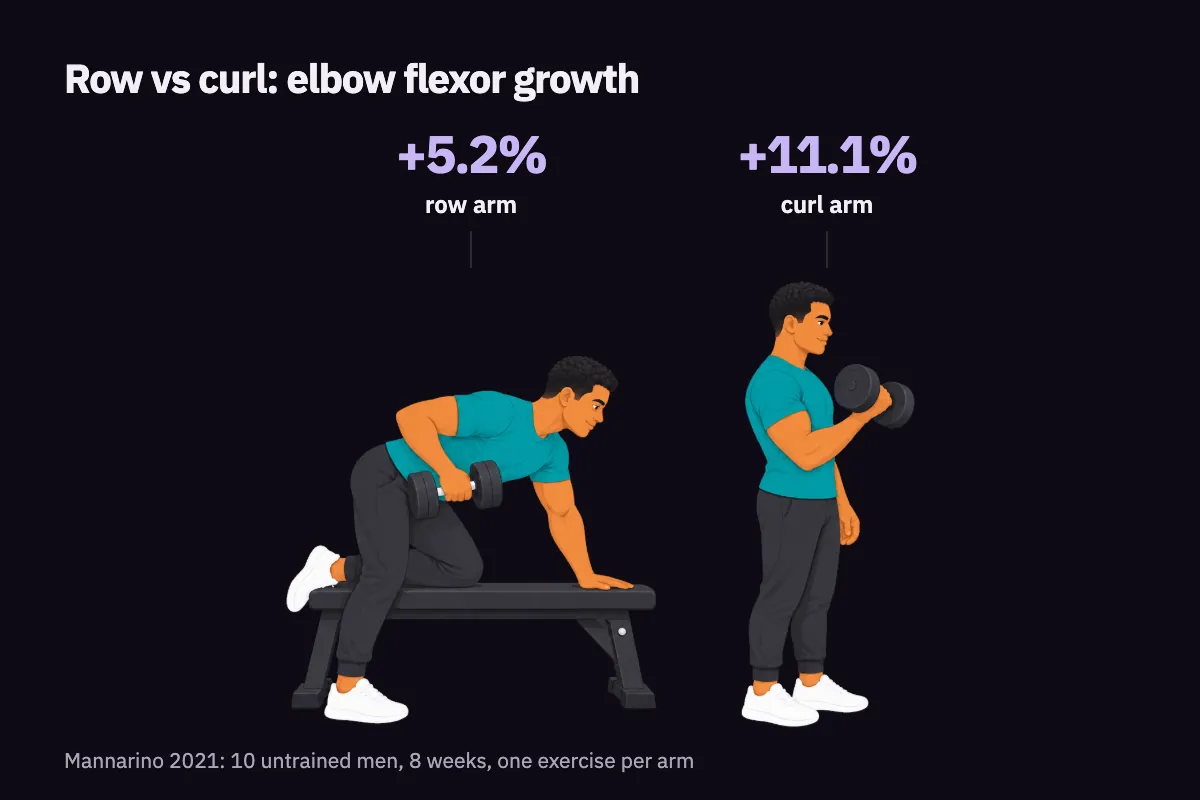
A small beginner study, but isolation hit the target muscle harder.
The honest summary: you can make good progress with few or no isolation exercises, but a few of them are a low-fatigue way to cover what the big lifts leave behind. Whether you use machines, cables or dumbbells for them is a separate choice, covered in free weights vs machines.
Which muscles do compound lifts under-train?
A starting checklist, not a rule:
| Muscle | Compounds that train it | Common gap and isolation option |
|---|---|---|
| Hamstrings | Romanian deadlift, deadlift; squats very little | Lying or seated leg curl |
| Rectus femoris (front thigh) | Squats grew it little in the study above | Leg extension |
| Side delts | Overhead press, partly | Lateral raise, dumbbell or cable |
| Rear delts | Rows, partly | Reverse pec deck, face pull |
| Biceps | Rows, pull-ups, pulldowns | Curls, if arms lag behind |
| Triceps long head | Presses, partly | Lying or overhead triceps extension |
| Calves | Little from squats or deadlifts | Standing or seated calf raise |
Isolation exercises also let you train a muscle at long lengths without loading your whole body, which is the angle covered in lengthened partials and long muscle length.
How to balance compounds and isolation with weekly sets
The simplest tool is a weekly count of hard sets per muscle. FitArchive counts a set as 1 for the exercise’s primary muscle and 0.5 for each secondary muscle, a common way to give partial credit to muscles that assist. The weekly sets guide explains the method; here is how it exposes gaps.
Example only: an upper-body week built from compounds, using FitArchive’s muscle mapping for each exercise.
| Exercise | Weekly hard sets | Primary muscle (1 set) | Secondary muscles (0.5 set) |
|---|---|---|---|
| Bench press | 6 | Chest | Front delts, triceps |
| Overhead press | 4 | Front delts | Side delts, triceps |
| Barbell row | 6 | Upper back, lats | Biceps, rear delts |
| Lat pulldown | 6 | Lats | Biceps, upper back |
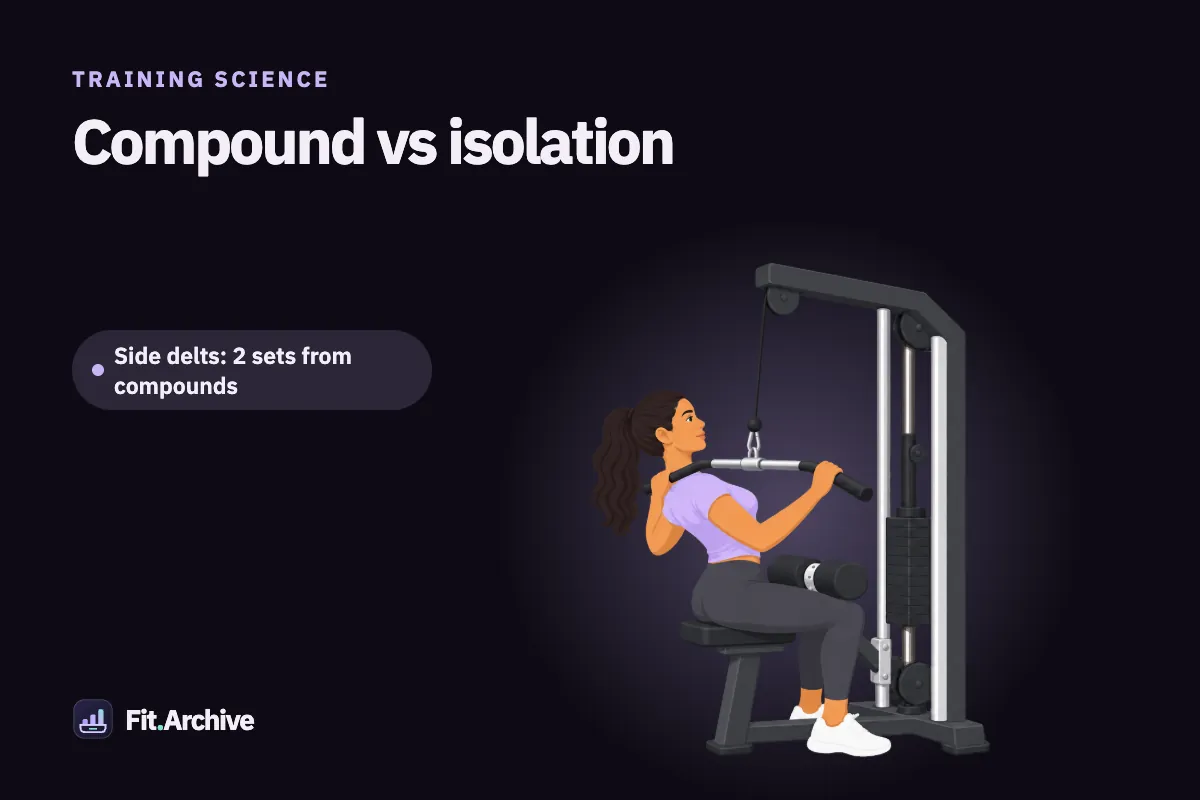
The weekly totals come out as: lats 12, upper back 9, front delts 7, chest 6, biceps 6, triceps 5, rear delts 3 and side delts 2. Side and rear delts stand out. Adding 4 sets of lateral raises and 3 sets of reverse pec deck lifts side delts to 6 and rear delts to 6 for roughly 15 extra minutes a week.
Partial credit is a convention, not a measurement. The pulldown study suggests a pulldown can grow the biceps nearly as well as a curl in beginners, so 0.5 may undercount there, while the squat study suggests the hamstrings get close to nothing from squats. Use the totals to spot obvious gaps, not to chase decimals. For how many weekly sets are worth doing, see junk volume and one set to failure.
An example week mixing both
Example program, not a prescription. Two full-body days, compounds first and isolation after, with sets × reps and a target RIR (reps in reserve):
| Day A | Sets × reps | Target RIR | Day B | Sets × reps | Target RIR |
|---|---|---|---|---|---|
| Back squat | 3 × 6 to 10 | 2 | Romanian deadlift | 3 × 8 to 12 | 2 |
| Bench press | 3 × 6 to 10 | 2 | Overhead press | 3 × 6 to 10 | 2 |
| Barbell row | 3 × 8 to 12 | 2 | Lat pulldown | 3 × 8 to 12 | 2 |
| Lateral raise | 3 × 12 to 20 | 1 | Lying leg curl | 3 × 10 to 15 | 1 |
| Cable curl | 2 × 10 to 15 | 1 | Triceps pushdown | 2 × 10 to 15 | 1 |
Compounds go first because they are the heaviest and most technical, and the ACSM review found strength gains were larger for exercises done at the start of a session. Isolation sets sit at 1 RIR because they are safer to push close to failure. FitArchive’s Full body 3 days template follows the same pattern: day A opens with back squat, bench press and barbell row, then finishes with lateral raises, cable curls and triceps pushdowns. If you are choosing a split, push/pull/legs vs upper/lower vs full body compares the options.
Common mistakes
- Assuming squats “cover legs”. Hamstrings and calves often get little from squats. Check them in your weekly counts.
- Counting secondary sets as full sets. Six sets of rows are not six sets of biceps work. Full credit inflates totals and hides gaps.
- Loading up on isolation while the main lifts stall. If curls and raises take most of your time and energy, your compounds may suffer. Keep compounds first.
- Judging isolation by the weight. Lateral raise loads climb slowly. Track reps at a given RIR instead; the progressive overload guide shows how.
- Changing several exercises at once. If you add isolation work and swap your compounds in the same week, you cannot tell what helped.
- Training through pain. Some joints tolerate one variation better than another. Pain is a reason to stop the exercise and get qualified advice, not a programming question.
Balancing exercises in FitArchive
FitArchive is a free, private training log that works in your browser. You log weight, reps and RIR for each set, and the Progress screen shows weekly hard sets by muscle (primary 1 set, secondary 0.5, working sets at 0 to 4 RIR) next to an estimated 1RM for each exercise, so a gap like low side delt volume shows up without a spreadsheet. The plan templates mix compound and isolation work, and you can edit them or build your own. You can look around with sample data in the demo.