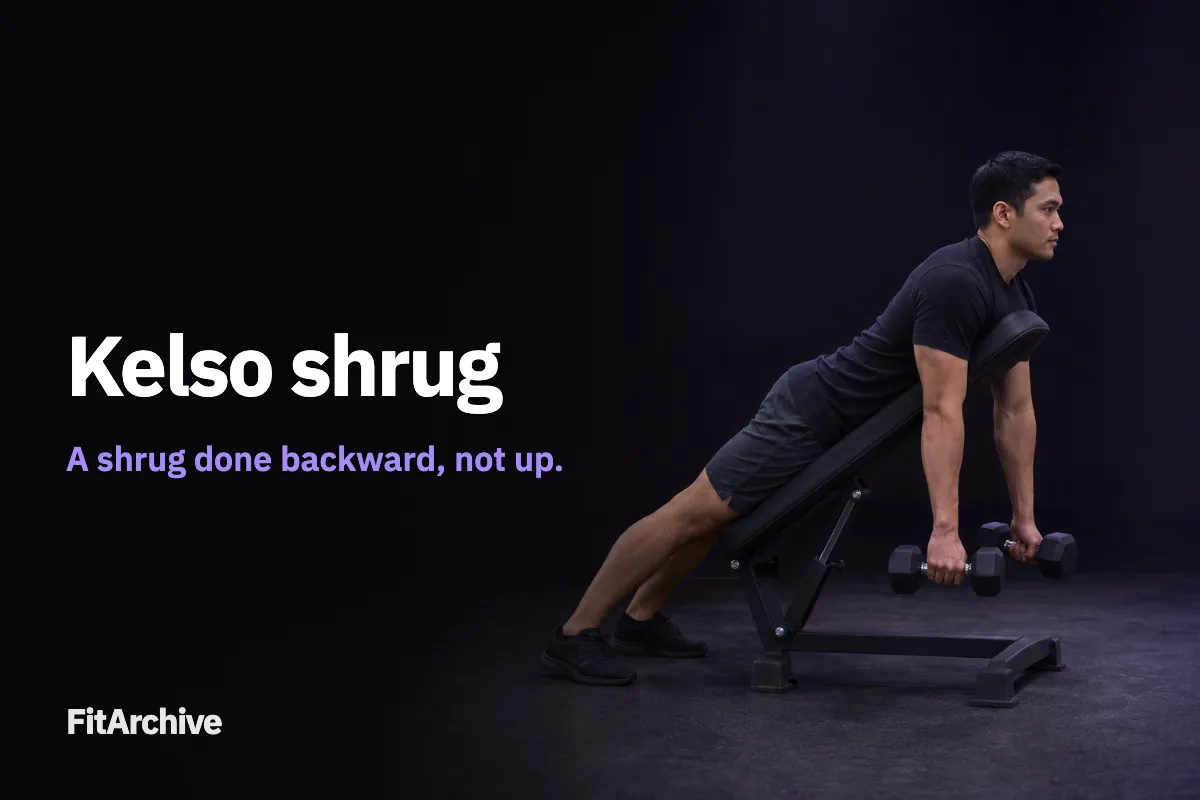
A Kelso shrug is a shrug done backward instead of up. You lie chest-down on an incline bench with straight arms and pull your shoulder blades together, so the weights rise only a few centimetres. That trains the middle traps and rhomboids, the muscles between your shoulder blades, which a regular shrug mostly misses. No study has tested the Kelso shrug itself. Muscle-activity studies support the idea that pulling the shoulder blades back works these muscles more than shrugging up, but nobody has shown it builds more upper back than a well-done row.
Pages online describe at least three different movements under this name. This guide uses the most common one, chest-supported retraction with straight arms, and explains how it differs from shrugs and rows.
How to do a Kelso shrug with dumbbells
The Kelso shrug as shown in FitArchive’s exercise library.
- Set an incline bench to about 30 to 45 degrees. Lie chest-down with your feet on the floor or the bench frame.
- Let the dumbbells hang straight under your shoulders, palms facing each other. Lifting straps are fine: your grip should not end the set.
- Keep your elbows straight (or fixed with a slight bend) and pull your shoulder blades together. The dumbbells rise only a few centimetres.
- Pause for a moment, then let your shoulder blades spread fully apart under control. The stretch at the bottom is part of the rep.
- Keep your chest on the pad and your head neutral. Do not shrug toward your ears.
Common mistakes:
- Bending the elbows. Then it turns into a row and the arms and lats join in, which changes the exercise.
- Shrugging up instead of back. That moves the work to the upper traps.
- Cutting the bottom short. Let the shoulder blades travel all the way apart.
- Going so heavy your chest lifts off the pad.
Machine, T-bar and other versions
The same movement works on any chest-supported setup:
- Chest-supported T-bar or row machine: chest on the pad, arms straight on the handles, squeeze the shoulder blades together without bending the elbows. This loads heavier than dumbbells.
- Smith machine: an incline bench under the Smith bar, lying chest-down, straight arms.
- Seated cable row: retraction-only reps with straight arms. Easier to set up, but without chest support it is easier to cheat with the torso.
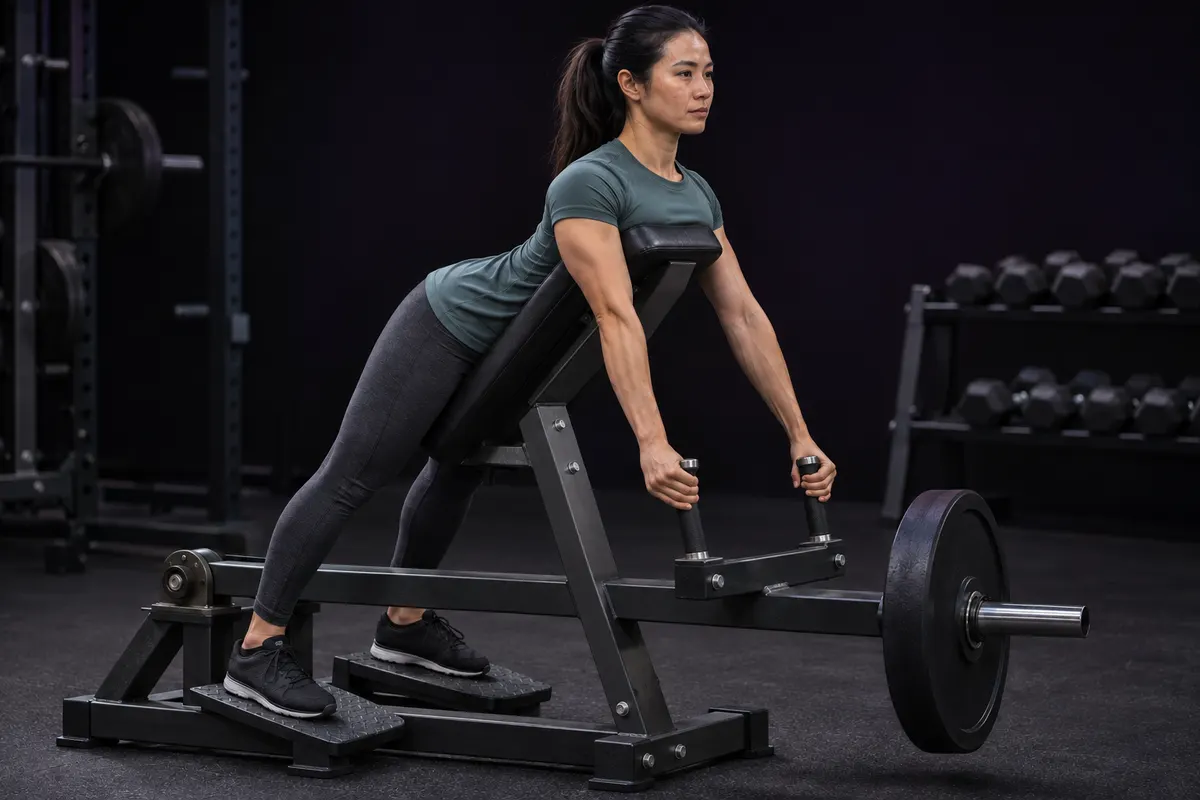
A Kelso shrug on a chest-supported row machine: arms stay straight, only the shoulder blades move.
What muscles does a Kelso shrug work?
- Middle trapezius and rhomboids: the main targets, the muscles that pull the shoulder blades together.
- Lower trapezius: helps.
- Rear delts: help a little.
- Upper trapezius: works, but less than in a regular shrug.
The evidence here comes from rehab and physiotherapy research on shoulder-blade exercises, not from the Kelso shrug itself:
- A 2003 EMG study of 30 people found the shrug gave the most upper trap activity of 10 exercises, while prone exercises that pulled the arm back gave the most middle trap activity.
- A 2016 study of 26 people using surface and fine-wire EMG found that rhomboid, middle trap and lower trap activity was significantly higher in a retraction exercise than in shrugs, while the upper trap stayed high in all of them.
- A 2012 study of 17 women found a one-arm row and prone abduction activated the middle trap 21 to 30% more than the upper trap.
So the logic is sound: pulling back trains different fibres than shrugging up. But EMG measures activity during a set, not growth over months, and none of these tested the Kelso shrug.
Kelso shrug vs regular shrug
| Regular shrug | Kelso shrug | |
|---|---|---|
| Direction | Shoulders up toward the ears | Shoulder blades back and together |
| Main target | Upper traps | Middle traps and rhomboids |
| Body position | Standing | Chest-supported on an incline |
| Typical load | Heavy | Moderate |
They train different parts of the same muscle group. If you want a thicker-looking upper back between the shoulder blades, the Kelso shrug is the more direct choice. If you want the traps on top of the shoulders, shrug up.
Kelso shrug vs rows
A chest-supported row already ends with the shoulder blades squeezed together, so it trains the same muscles plus the lats and biceps. The argument for a Kelso shrug is that in a row, the arms or lats may tire before the muscles between the shoulder blades get a hard set. That is plausible, but it has not been measured.
Practical answer: rows should come first in most programs because they train more muscle at once. Add Kelso shrugs if your upper back is a priority, or do them straight after your rows to finish those muscles off. More on the trade-off in compound vs isolation exercises.
Sets, reps and programming
- Reps: 8 to 15, with a short pause at the top.
- Sets: 2 to 3, once or twice a week, usually after rows.
- Effort: end the set when you can no longer pull the shoulder blades fully together with your chest on the pad. Do not turn the last reps into rows.
- Progress: the range is small and dumbbells jump in steps, so add reps first, then weight, as in double progression.
Is it enough for the traps or upper back? Not on its own. The upper back also gets work from every row and pulldown. Count those when you plan weekly volume; the weekly sets guide explains how. Feeling the shoulder blades move helps you keep the right pattern, as covered in mind-muscle connection.
Alternatives to the Kelso shrug
- Chest-supported row with a one-second squeeze at the top
- Face pull
- Reverse pec deck or rear delt fly
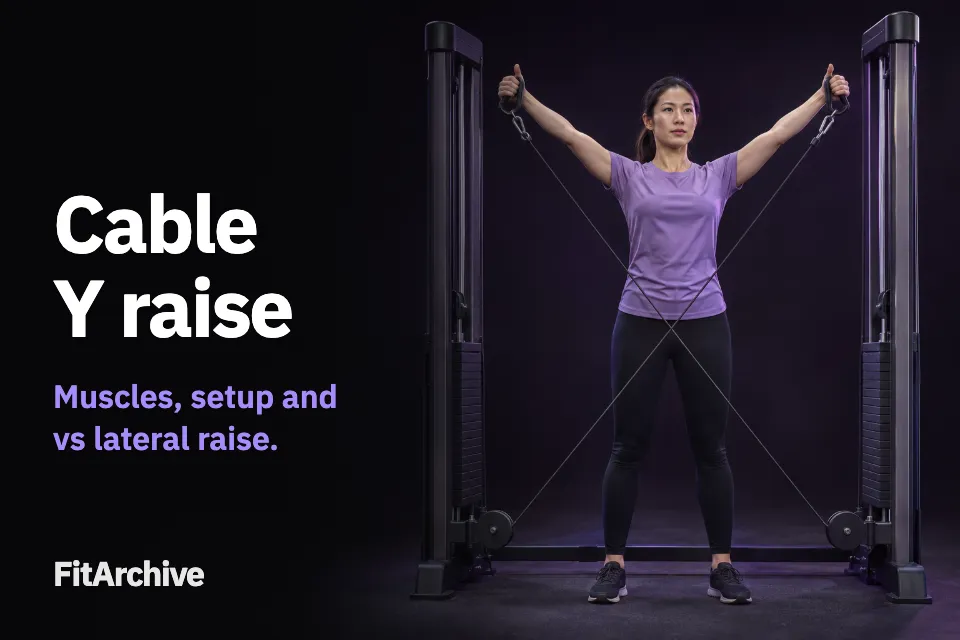
- Prone Y or T raises on an incline bench; a cable Y raise also works the upper back, but with an overhead arm raise rather than pure retraction
Track your Kelso shrugs in FitArchive
FitArchive has the Kelso shrug in its exercise library with a short demonstration clip, and you can find it by searching “chest-supported shrug” or “incline shrug” too. It counts as upper back work, alongside rows and face pulls. Log weight, reps and RIR for each set, and the Progress screen shows your weekly hard sets for the upper back and your estimated one-rep max for every exercise. FitArchive does not split the traps into upper and middle, so treat the upper back total as the whole region.
Get FitArchive free on iPhone or Android. Logging and your full history are free, with no ads.