FBEOD vs PPL is a choice between frequency and volume per session. FBEOD (full body every other day) trains your whole body, rests a day and repeats: about 3.5 sessions a week, each muscle hit 3.5 times, usually with 1 to 2 sets per exercise. PPL (push, pull, legs) run twice through takes 6 days and trains each muscle twice a week with more sets in each session. Studies find similar muscle growth across frequencies when weekly sets are equal, so neither split wins on its own. Pick FBEOD if you have 3 to 4 flexible days and like short, varied sessions; pick six-day PPL if you can train most days and want more weekly sets per muscle.
Both splits are popular answers to “which program should I run?”. This guide puts them side by side on days, frequency, weekly sets per muscle and session length, using our FBEOD example program and FitArchive’s Push/Pull/Legs · 6 days template, then checks what the research supports.
What FBEOD and PPL mean
FBEOD stands for full body every other day. Every session trains the whole body, there is always one rest day between sessions, and you usually alternate two workouts, A and B. Because a week has seven days, the training days shift: 7 sessions every 14 days, or 3.5 a week. Our FBEOD guide explains the rotation in full.
PPL groups muscles by movement: push (chest, shoulders, triceps), pull (back, biceps, rear delts) and legs. Run twice through, it takes 6 days and trains each muscle twice a week. Run once, it takes 3 days and trains each muscle once. The PPL vs Arnold split guide covers PPL’s layout in more detail.
FBEOD vs PPL compared
| FBEOD | PPL (6 days) | PPL (3 days) | |
|---|---|---|---|
| Sessions per week | 3.5 on average | 6 | 3 |
| Sessions per muscle per week | About 3.5 | 2 | 1 |
| Rest days per week | 3.5 on average | 1 | 4 |
| Training weekdays | Shift every week | Fixed | Fixed |
| Exercises per session (examples below) | 13 | 5 to 6 | Usually more than six-day PPL, to fit a muscle’s weekly sets into one day |
| Sets per exercise | 1, 2 at most | 2 to 4 | Usually 3 or more |
| Cost of a missed session | Small: everything returns within 2 days | Some muscles get 1 session that week | That muscle group skips the whole week |
The table shows the main tradeoff. FBEOD spreads a muscle’s work thinly over many sessions. PPL packs more work for fewer muscles into each session.
Weekly sets per muscle: two examples
These are example totals, counting working sets only and only exercises where the muscle is the main target. FBEOD figures come from the A/B program in our FBEOD guide at 3.5 sessions a week; PPL figures come from FitArchive’s Push/Pull/Legs · 6 days template.
| Muscle | FBEOD example (per week) | Push/Pull/Legs · 6 days template (per week) |
|---|---|---|
| Chest | About 5 | 11 |
| Back (rows and pulldowns) | About 9 | 16 |
| Quads | 7 | 13 |
| Hamstrings | About 5 | 9 |
| Shoulders (presses and lateral raises) | 3.5 | 12 |
| Rear delts | About 2 | 6 |
| Biceps | 3.5 | 10 |
| Triceps | 3.5 | 10 |
| Calves | 3.5 | 8 |
| Glutes (hip thrust) | About 2 | 3 |
| Adductors | About 2 | 0 |
| Abs | 3.5 | 0 |
| Total working sets per week | 49 | 98 |
| Working sets per session | 13 to 15 | 15 to 18 |
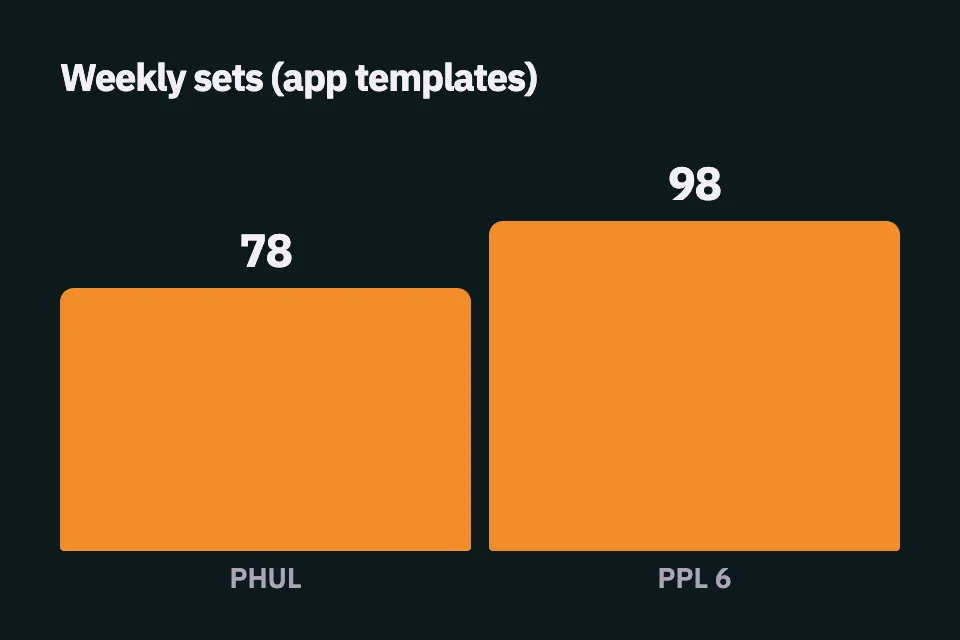
So the two examples are not equal programs: the PPL template does about twice the weekly sets. That is typical of how each split is used. FBEOD sessions already hold 13 exercises; to reach the PPL template’s 98 weekly sets at 3.5 sessions a week, each FBEOD session would need about 28 sets. Six-day PPL reaches that volume with sessions of 15 to 18 sets.
What this means in practice:
- FBEOD suits low to moderate weekly volume. It gives each muscle many short, fresh exposures. If a muscle falls behind, the FBEOD guide suggests a second set on one of its exercises first.
- Six-day PPL suits higher weekly volume. It fits 10 or more weekly sets for most muscles without very long sessions.
- Neither number is a target. Use how to count weekly sets per muscle to check whatever plan you run.
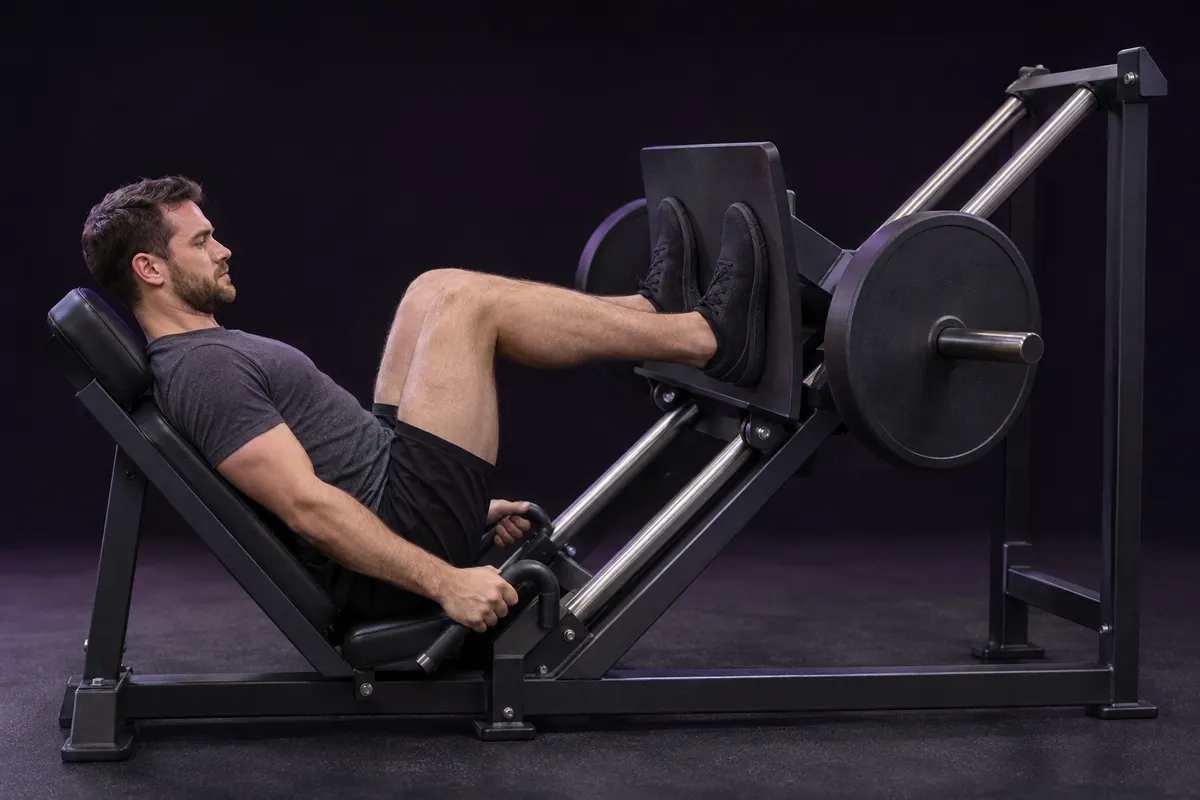
FBEOD trains legs in every session; six-day PPL gives them two dedicated days a week.
Which builds more muscle? What research says
No study has compared FBEOD and PPL directly, so the evidence is indirect:
- Split type matters little when volume is equal. A 2024 meta-analysis by Ramos-Campo and colleagues pooled 14 studies with 392 participants and found similar gains in strength and muscle size for split and full-body routines with volume equated.
- Training a muscle more often adds little at the same weekly sets. A 2019 meta-analysis found no clear difference in muscle growth between training a muscle 1, 2 or 3 or more times a week once volume was equated. A 2019 trial in 27 trained men found that 3 and 6 sessions a week at equal weekly volume gave similar strength and muscle gains on most measures over 6 weeks.
- Weekly sets matter more. A 2026 meta-regression of 67 studies found muscle growth rose with weekly sets, with diminishing returns, while frequency had little identifiable effect on growth once volume was counted (it did help strength).
Put together: at equal weekly sets, expect FBEOD and six-day PPL to build similar muscle. In real use, PPL programs often carry more weekly sets, as the two examples above do, which may help lifters who recover well and respond to more volume. FBEOD’s case is practical: short sessions, a rest day after every workout, and little lost when you miss one. These studies were small and short, mostly in young men, and none tested either split exactly as written here.
FBEOD vs 3-day PPL
If you only have 3 or 4 days, the real choice is often FBEOD against PPL run once a week. Both can work. The difference is how a muscle’s weekly sets are spread:
- 3-day PPL trains each muscle once, so all of its weekly sets land in one session. Ten chest sets in a single push day means the last sets are done tired.
- FBEOD trains each muscle about 3.5 times, so the same muscle gets several first sets a week, done fresh.
Research at equal volume has not shown a clear growth difference between once and several times a week, so this is a practical argument, not a proven one. Still, with only 3 days, a full-body or upper/lower plan usually spreads the work more evenly than a once-through PPL.
Who should pick FBEOD, and who PPL?
Pick FBEOD if:
- You can train 3 to 4 days a week, but not on the same weekdays every week (shift work, study, travel).
- You like short sessions with many exercises and only 1 or 2 hard sets each.
- You want a rest day after every session.
- You are newer to lifting and benefit from practising the main lifts often.
Pick six-day PPL if:
- You can train 6 days most weeks and recover well (sleep, food, stress).
- You want more weekly sets per muscle than FBEOD comfortably fits.
- You prefer fixed weekdays and sessions focused on a few muscles.
- You like several sets of the same exercise to settle into a lift.
Switching between FBEOD and PPL
- From PPL to FBEOD: pick one exercise per movement for each workout and cut to 1 hard set per exercise, 2 for a priority muscle. Do not copy 3 to 4 sets per exercise from PPL: at 3.5 sessions a week that adds up fast.
- From FBEOD to PPL: group the exercises into push, pull and legs days and raise each to 2 to 4 sets. Fix your weekdays, since PPL depends on finishing all six days.
- Either way: keep the same exercises where you can, so your logged numbers stay comparable, and give the new split 8 to 12 weeks before judging it. Use double progression: add reps within the range, then add weight.
Common mistakes
- Comparing splits at very different volumes. If one program has twice the weekly sets, the split’s name is not what made the difference.
- Running six-day PPL on a three- or four-day week. Missed sessions leave some muscles trained once or not at all that week.
- Taking every FBEOD set to failure on squats and deadlifts. With one day between sessions, keep a rep or two in reserve on the heaviest lifts.
- Forcing FBEOD onto fixed weekdays. Doing workout A every Monday breaks the every-other-day spacing and creates back-to-back days.
- Judging a split after two weeks. Give it 8 to 12 weeks of consistent logging.
Running FBEOD or PPL in FitArchive
FitArchive includes a Push/Pull/Legs · 6 days template and a Full Body · 3 days template for alternate-day training. The full-body template uses 2 to 4 sets per exercise, so lower it to 1 or 2 sets per exercise to run it every other day, or build your own A/B plan from the FBEOD guide. Your next workout follows the plan’s order, not the weekday, so a missed day does not break the rotation. Each set records weight, reps and RIR, and the Progress screen shows weekly hard sets and training days per muscle, so you can see what your split actually delivers. Try it with sample data in the demo.