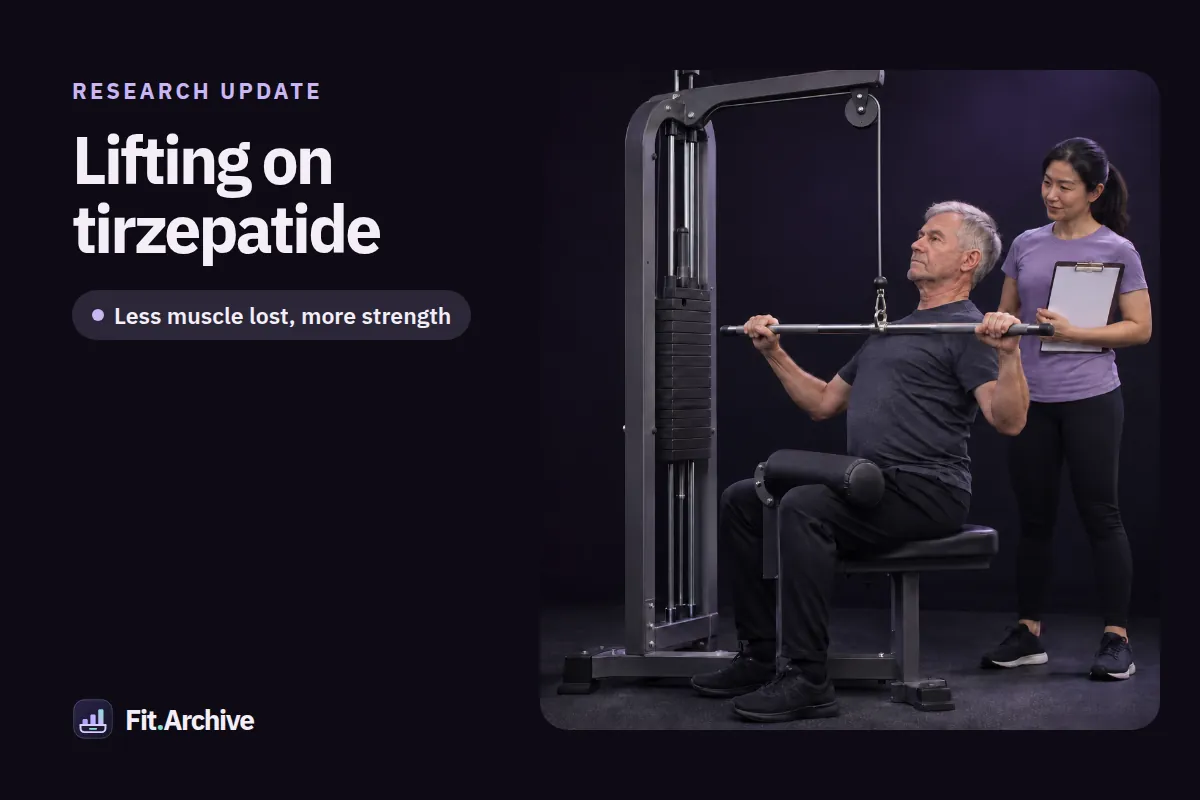
Does lifting weights on tirzepatide (Mounjaro, Zepbound) prevent muscle loss? It reduces muscle loss rather than preventing it, and it protects strength. In a new 40-week randomised trial in Nature Medicine, 120 adults all took tirzepatide and lost about 22 kg. Those who also did supervised resistance training three times a week lost 3.57 kg of lean mass instead of 4.67 kg, and their strength rose by 10.7% to 17.5% while the non-lifting group got 6.5% to 9.0% weaker. Fat loss was the same in both groups.
This is FitArchive’s research update. For each paper we say what was tested, what it found, how much weight to give it, and what, if anything, to change. The paper is open access, so we read the full text, not only the abstract. It was published on 9 November 2026. This is not advice about any medicine: decisions about tirzepatide or any GLP-1 drug belong with your doctor.
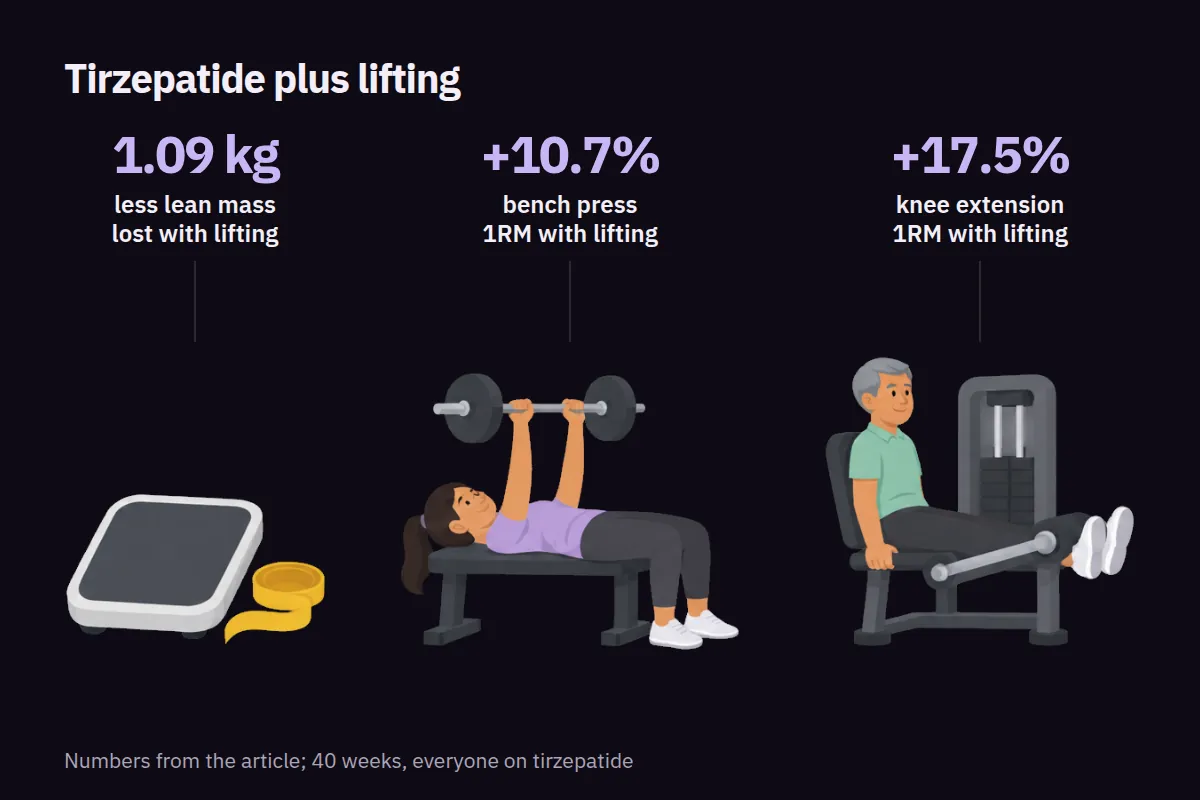
What the trial measured: body composition on a scan, and strength on the bench press, lat pulldown and knee extension.
Why this trial matters
Two days ago we covered new research on GLP-1 drugs and muscle loss. In a large Lancet trial, people taking semaglutide lost 6.6% of their lean mass in 26 weeks. None of the studies in that update tested resistance training, which is the one tool you control. This trial did exactly that, with tirzepatide, the drug sold as Mounjaro and Zepbound.
A note on terms: the trial measured lean soft tissue mass with a DXA scan. That is everything except fat and bone, so it includes water and organs as well as muscle. A smaller drop in lean mass is a good sign, not a direct count of muscle kept.
The study: does lifting cut muscle loss on tirzepatide? (T-REx)
The paper. Green and colleagues, Nature Medicine, published online on 9 November 2026. Peer-reviewed, randomised controlled trial at a single centre in Australia. Eli Lilly supplied the tirzepatide and reviewed the trial protocol and a draft of the paper (for intellectual-property and safety issues; no changes were made), but provided no other funding and had no role in running the trial. Three authors, including the lead author, have received speaker fees from Lilly, and one has also advised the company. The lead author also reports support from a Western Australian state government research award.
Who took part. 120 adults, 60 men and 60 postmenopausal women, average age 57.7 (range 50 to 70). 87% had obesity and 13% overweight. They did not have diabetes or heart disease and were sedentary at the start, so these were beginners, not trained lifters.
What they did. Everyone got a weekly tirzepatide injection for 40 weeks, starting at 2.5 mg and increasing every 4 weeks toward 15 mg (most reached it). Half were randomly assigned to keep their usual activities; the other half also did resistance training:
- Three 1-hour group sessions a week in a gym, supervised by accredited exercise physiologists.
- Five 8-week blocks. The first block used light to moderate loads to learn technique; later blocks mixed hypertrophy and strength sessions with progressive overload, at moderate to vigorous effort guided by a 1–10 RPE scale.
- Each session alternated upper and lower body exercises: squats, deadlifts, leg press, leg extension, lat pulldowns, shoulder press, biceps curls and chest press were among them.
Both groups were told to keep up protein, fibre and fluids; there was no special diet. In the people who kept food diaries, calorie and protein intake were similar in both groups. Attendance at the training sessions averaged 91%, and 93% of participants finished the trial.
What they found (40 weeks).
| Outcome | Tirzepatide only | Tirzepatide + lifting |
|---|---|---|
| Body weight | −22.61 kg | −22.28 kg |
| Fat mass | −17.19 kg | −17.98 kg |
| Lean soft tissue mass | −4.67 kg | −3.57 kg |
| Arm and leg lean mass | −3.55 kg | −2.92 kg |
| Bench press 1RM | −4.09 kg (−8.4%) | +4.68 kg (+10.7%) |
| Lat pulldown 1RM | −4.42 kg (−6.5%) | +8.58 kg (+15.7%) |
| Knee extension 1RM | −4.42 kg (−9.0%) | +5.88 kg (+17.5%) |
- Weight and fat loss were the same in both groups. The difference in fat loss (−0.77 kg) was not statistically significant.
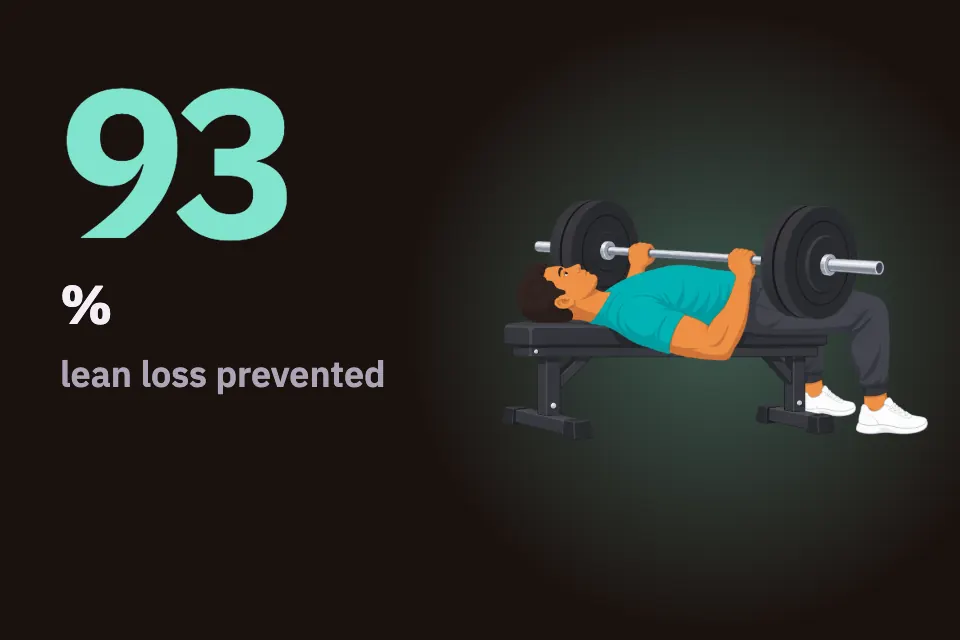
- Lifting reduced lean-mass loss by 1.09 kg (confidence interval 0.43 to 1.75 kg). By our arithmetic, lean mass made up about 21% of the weight lost without lifting and about 16% with it.
- The strength gap between groups was large: 8.59 kg on the bench press, 12.97 kg on the lat pulldown and 9.78 kg on the knee extension.
- Feeling tired or weak was reported by 14.8% of the tirzepatide-only group and 16.9% of the lifting group, even though only the non-lifters actually got weaker. How you feel was not a good guide to your strength.
- Side effects such as nausea were common and similar in both groups. Six serious adverse events occurred; the investigators judged none of them related to the drug or the training.
How much weight to give it: high for the main question, moderate for applying it to you. It is a randomised trial with 40 weeks of follow-up, few dropouts, high attendance, DXA scans every 8 weeks and strength tested the same way in both groups. The limits:
- The participants were sedentary adults aged 50 to 70 without diabetes. Younger people, trained lifters and people with diabetes were not studied.
- Training was supervised, in a group, three times a week. The authors say it is not yet known how well this works in routine practice, where most people train alone.
- The exercise could not be hidden from participants or the staff who ran the strength tests. Body composition was read by blinded analysts.
- Lifting reduced lean-mass loss but did not prevent it. The authors suggest that weight loss this large limits how much muscle training can build.
- Lean mass on DXA is not the same as muscle, and the trial did not measure long-term health outcomes.
How it fits the existing evidence
It fills the gap left by the drug trials. The Lancet COURAGE trial showed that semaglutide weight loss comes with meaningful lean-mass loss and tested an experimental antibody to reduce it. This trial shows that ordinary progressive resistance training reduced lean-mass loss on tirzepatide by about a quarter (1.09 of 4.67 kg) and, more importantly, turned a loss of strength into a gain. It also fits what is known about dieting without drugs: lifting during a calorie deficit helps keep muscle and strength, while fat loss depends mostly on the deficit itself.
What this means if you lift
- Lift during the weight loss, as the trial did. In this trial the lifters trained throughout the 40 weeks of weight loss, and three full-body sessions a week was enough for these beginners to get stronger. The FitArchive template Full Body · 3 days is a simple place to start, or Minimalist · 2 days if three days a week is not realistic (the trial used three).
- Progress the load. The trial’s programme was progressive: weights went up as people got stronger, guided by effort ratings. Our guide to tracking progressive overload shows how.
- Track strength, not just the scale. The non-lifters lost 6.5% to 9.0% of their strength, and feeling weak did not predict who got weaker. A log of your main lifts shows it early.
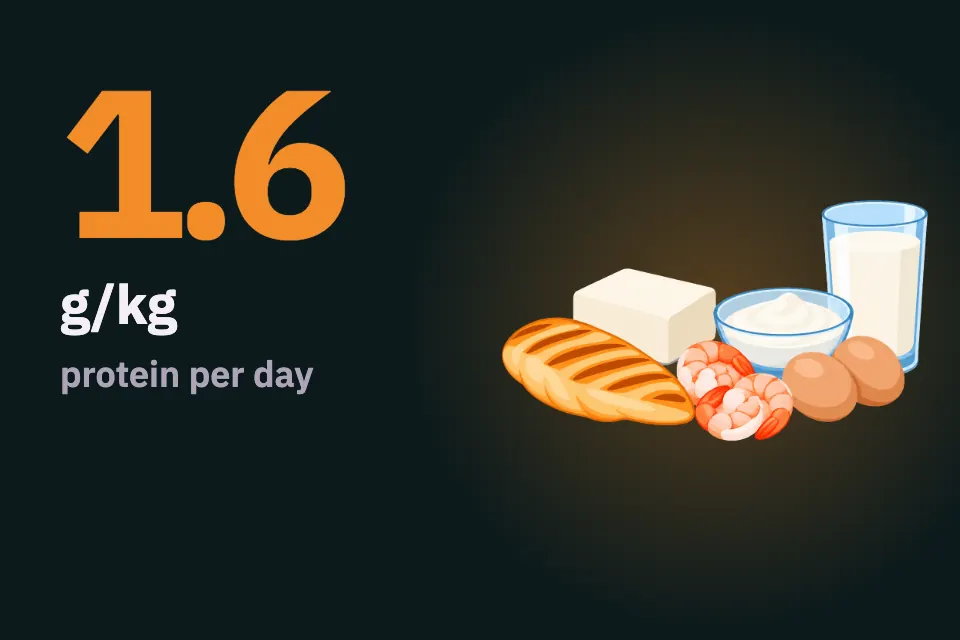
- Keep protein up when appetite is low. The trial only told people to maintain protein, so it does not tell you the best amount. See how much protein per day for the targets studied in lifters, and how to keep muscle while cutting for the rest of the setup.
- If you are over 50, this study was about your age group. Our guide to strength training over 50 covers how to start safely.
- Talk to your doctor before starting a new exercise programme alongside a weight-loss medicine, and about how fast you are losing weight.
| If you are… | Based on this trial, consider… |
|---|---|
| On tirzepatide or a similar drug and not lifting | Asking your doctor about starting supervised or structured resistance training |
| On a GLP-1 drug and already lifting | Logging your main lifts and protein so you notice early if either drops |
| Expecting lifting to stop all muscle loss | Knowing it reduced lean-mass loss by about a quarter, not to zero |
| A trained lifter at a normal weight | Knowing this trial did not study you; the general principles still apply |
How we judge new research
- Design first: randomised trials and meta-analyses over single observations.
- Who was studied: sedentary adults aged 50 to 70 with overweight or obesity, not trained lifters.
- What was measured: lean mass on a scan includes water and organs; strength tests add a practical signal.
- Who paid: the drug maker supplied the drug and reviewed the protocol and a draft, and three authors have received speaker fees from it, which we state.
- Fit with the existing evidence: we say whether a paper confirms, refines or challenges what was already known.
This article summarises research for general education. It is not medical advice or a personal training or diet prescription. Never start, stop or change a medicine such as tirzepatide without your doctor. If you have a medical condition or are planning a large weight change, talk to a doctor first.
Track lifts, protein and your weight trend in FitArchive
FitArchive logs each set’s weight, reps and reps in reserve, and logs meals with daily calories and protein. Record one body weight reading a day to see a smoothed weight trend with the change per week, and add waist measurements in centimetres, so you can see whether strength holds while the scale moves. Try it with sample data in the demo.