Does weight loss on a GLP-1 drug cost muscle? In a new 975-person trial in The Lancet, people with obesity taking semaglutide plus a placebo lost 6.6% of their lean mass in 26 weeks, next to 15.6% of their fat mass. An experimental antibody given alongside semaglutide cut the lean-mass loss by about 3 percentage points. A separate 30-study meta-analysis found that surgery’s larger lean-mass loss in kilograms came with its larger weight loss, with no sign that either treatment preserved lean mass worse relative to the weight lost. Neither study tested lifting, which is still the part you control.
This is FitArchive’s research update. For each paper we say what was tested, what it found, how much weight to give it, and what, if anything, to change. We read the abstracts; where a detail was not reported there, we say so rather than guess. Both new papers appeared online between 11 and 13 November 2026. This is not advice about any medicine: decisions about GLP-1 drugs belong with your doctor.
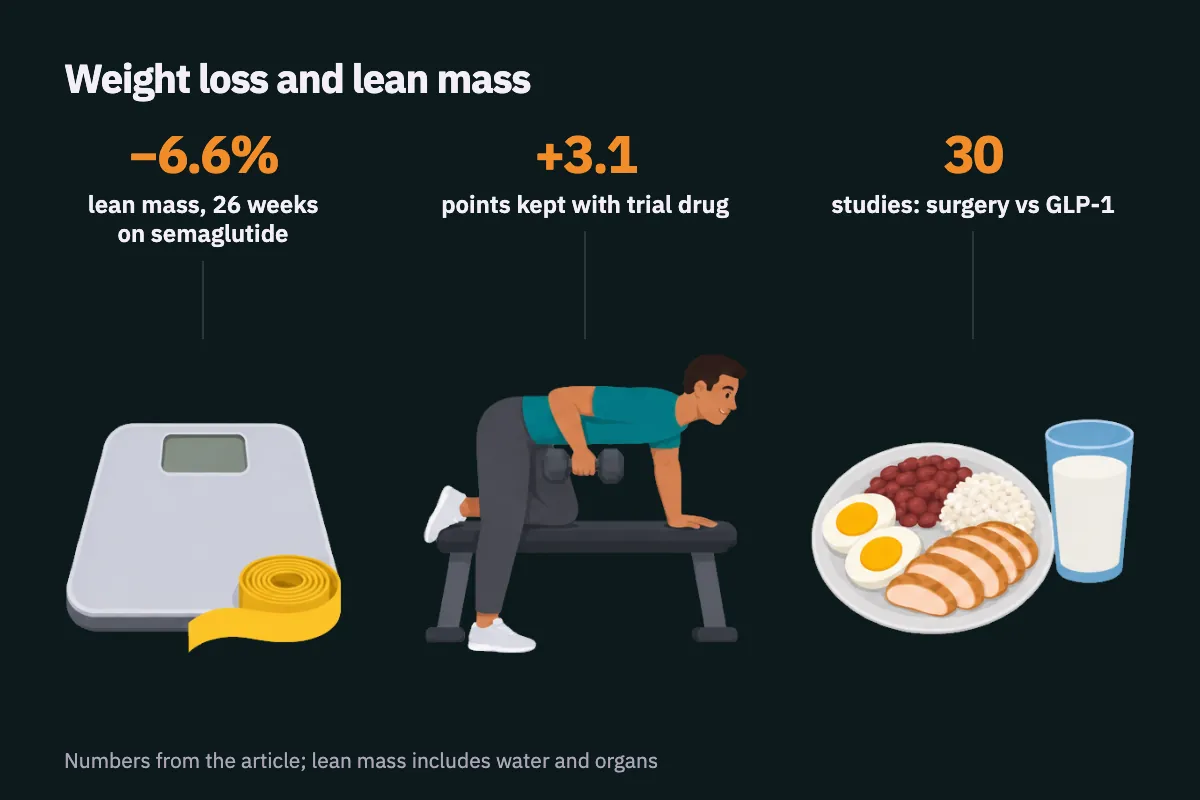
What the studies measured, and the two levers they did not test: lifting and food.
First, what “lean mass” means
Both papers report lean mass, usually measured with a DXA scan or bioelectrical impedance. Lean mass is everything that is not fat or bone: muscle, but also water, organs and connective tissue. So a drop in lean mass is not the same as an equal drop in muscle, and a gain is not proof of new muscle. It is still the standard way to track whether weight loss is coming from fat or from everything else.
Study 1: a drug to protect muscle during semaglutide weight loss (COURAGE)
The paper. Mosenzon and colleagues, The Lancet, published online on 11 November 2026. Two-part, phase 2, double-blind, placebo-controlled randomised trial at 60 sites in the United States, funded by Regeneron, the company developing the antibodies.
What they did. 975 adults with obesity (BMI 30 or more; average age 49, average BMI 36.7; 64% women) all took semaglutide, titrated up to 2.4 mg once a week. On top of that, they were randomly given either a placebo or trevogrumab, an experimental antibody that blocks myostatin (GDF8), a protein that limits muscle growth. One group also got garetosmab, a second antibody that blocks activin A. Part A lasted 26 weeks (605 people); part B lasted 52 weeks with lower trevogrumab doses (376 people). The main outcomes were the percentage change in lean mass, fat mass and body weight.
What they found.
| Group (part A, 26 weeks) | Lean mass change vs semaglutide + placebo |
|---|---|
| Semaglutide + placebo | −6.6% from baseline |
| + trevogrumab 200 mg | +3.1 percentage points |
| + trevogrumab 400 mg | +2.7 percentage points |
| + trevogrumab 400 mg + garetosmab | +4.5 percentage points |
- In the placebo group, fat mass fell 15.6% and body weight 10.6% in 26 weeks, so lean mass made up a real share of what was lost.
- In part B, the placebo group lost 7.3% of lean mass over 52 weeks. Trevogrumab 75 mg reduced that loss by 3.1 percentage points; the 25 mg dose’s difference (+1.5) was not statistically clear.
- Trevogrumab alone was generally well tolerated, with a safety profile similar to placebo. The two-antibody combination improved body composition most, but 14 of 149 people (9%) had serious adverse events, 48 of 149 (32%) stopped treatment, and 41% had muscle spasms. Two deaths occurred in that group; the investigators did not identify a causal link to treatment.
How much weight to give it: high for the main question, low for practical use. It is a large, double-blind, randomised trial, and it confirms clearly that semaglutide weight loss comes with meaningful lean-mass loss. But trevogrumab is an experimental drug, not something you can get, and phase 2 trials are not built to prove long-term safety. The authors themselves say it is not yet known whether keeping more lean mass improves physical function or health. An MRI sub-study of thigh muscle was run, but its results are not in the abstract. The abstract also does not say whether participants did any exercise or how much protein they ate.
How it fits. Losing some lean tissue along with fat happens with any substantial weight loss, whether from diet, surgery or medication. What makes GLP-1 drugs different is speed and size: large losses in a few months. This trial shows the lean-mass share is big enough that drug makers are now testing add-on medicines to protect it.
Study 2: bariatric surgery vs GLP-1 drugs, fat and lean mass
The paper. Urbina and colleagues, Obesity Surgery, published online on 13 November 2026. Systematic review and meta-analysis.
What they did. The authors reviewed 31 studies and pooled 30 of them, with 5,616 participants, comparing weight, fat-mass and lean-mass changes after metabolic and bariatric surgery or GLP-1-based drug therapy. Because DXA and impedance scales give different numbers, they analysed each measurement method separately, with 12 months as the main time point.
What they found.
- Surgery was associated with more total weight loss and more fat loss in kilograms than GLP-1-based drugs, with both measurement methods.
- Surgery was also associated with more lean-mass loss in kilograms, but that went with the larger weight loss. The authors found no evidence that surgery preserved lean mass worse as a proportion of the weight lost.
- Results varied a lot between studies (substantial heterogeneity). The abstract does not report the pooled numbers, so we do not quote any.
How much weight to give it: moderate. It pools many studies, but the comparison is indirect: different studies, different patients, no head-to-head trials. The authors warn against reading it as a direct treatment comparison and call for studies that also measure strength and physical function.
How it fits. It lines up with the Lancet trial: lean-mass loss in kilograms tracked the size of the weight loss with both methods. The lesson is about the size of the loss, not a special muscle-wasting effect of one treatment.
Context: what happened when exercise was added
These two papers did not test exercise. An earlier randomised trial did, and its two-year follow-up (Jensen and colleagues, EClinicalMedicine, 2024) is worth knowing. After an 8-week low-calorie diet, adults with obesity spent a year on a supervised exercise programme, the GLP-1 drug liraglutide, both, or placebo, and were then followed for a year without treatment.
- One year after treatment stopped, the group that had combined exercise with liraglutide weighed 5.1 kg less and had 2.3 percentage points less body fat than the group that had taken liraglutide alone.
- During that year off treatment, people who stopped liraglutide regained 6.0 kg more than people who stopped the supervised exercise programme.
How much weight to give it: moderate. It is randomised, but only 109 people came back for the follow-up, it used liraglutide rather than newer drugs, and the abstract does not say what kind of exercise the programme involved. It suggests that habits built alongside the drug last longer than the drug’s effect after stopping; it does not measure muscle specifically.
What this means if you lift
None of these studies tested resistance training, so they cannot tell you how much lifting protects muscle on a GLP-1 drug. What they do show is that lean-mass loss during fast weight loss is real and sizeable. The tools lifters already use to keep muscle during any diet are the ones within your control:
- Keep lifting with real effort. Training each muscle a couple of times a week, close to failure, gives the body a reason to keep muscle while you are eating less. Our guide to keeping muscle while cutting covers how to set it up.
- Keep protein high when appetite is low. GLP-1 drugs reduce appetite, which makes protein easy to under-eat. See how much protein per day for the targets studied in lifters.
- Watch strength, not just the scale. If your main lifts hold steady while body weight falls, that is a practical sign you are not losing much muscle. Lean-mass scans also count water and organs, so strength and waist size are useful extra signals.
- Talk to your doctor about how fast you are losing weight. Faster loss means more lean tissue at risk, and only your doctor can adjust the medicine.
| If you are… | Based on these papers, consider… |
|---|---|
| On a GLP-1 drug and not lifting | Asking your doctor about starting resistance training |
| On a GLP-1 drug and lifting | Logging protein and your main lifts so you notice early if either drops |
| Hoping for a muscle-protecting drug | Knowing it is still experimental; the strongest option showed safety problems |
| Comparing surgery and medication | Knowing lean-mass loss tracked the amount of weight lost with both |
How we judge new research
- Design first: randomised trials and meta-analyses over single observations.
- Who was studied: adults with obesity on medication or after surgery, not trained lifters at a normal weight.
- What was measured: lean mass on a scan includes water and organs, so it is a partial picture of muscle.
- Who paid: the Lancet trial was funded by the company developing the drug, which we state.
- Fit with the existing evidence: we say whether a paper confirms, refines or challenges what was already known.
This article summarises research for general education. It is not medical advice or a personal training or diet prescription. Never start, stop or change a medicine such as a GLP-1 drug without your doctor. If you have a medical condition or are planning a large weight change, talk to a doctor first.
Track lifts, protein and your weight trend in FitArchive
FitArchive logs each set’s weight, reps and reps in reserve, and logs meals with daily calories and protein. Record one body weight reading a day to see a smoothed weight trend with the change per week, and add waist measurements in centimetres, so you can see whether strength holds while the scale moves. Try it with sample data in the demo.