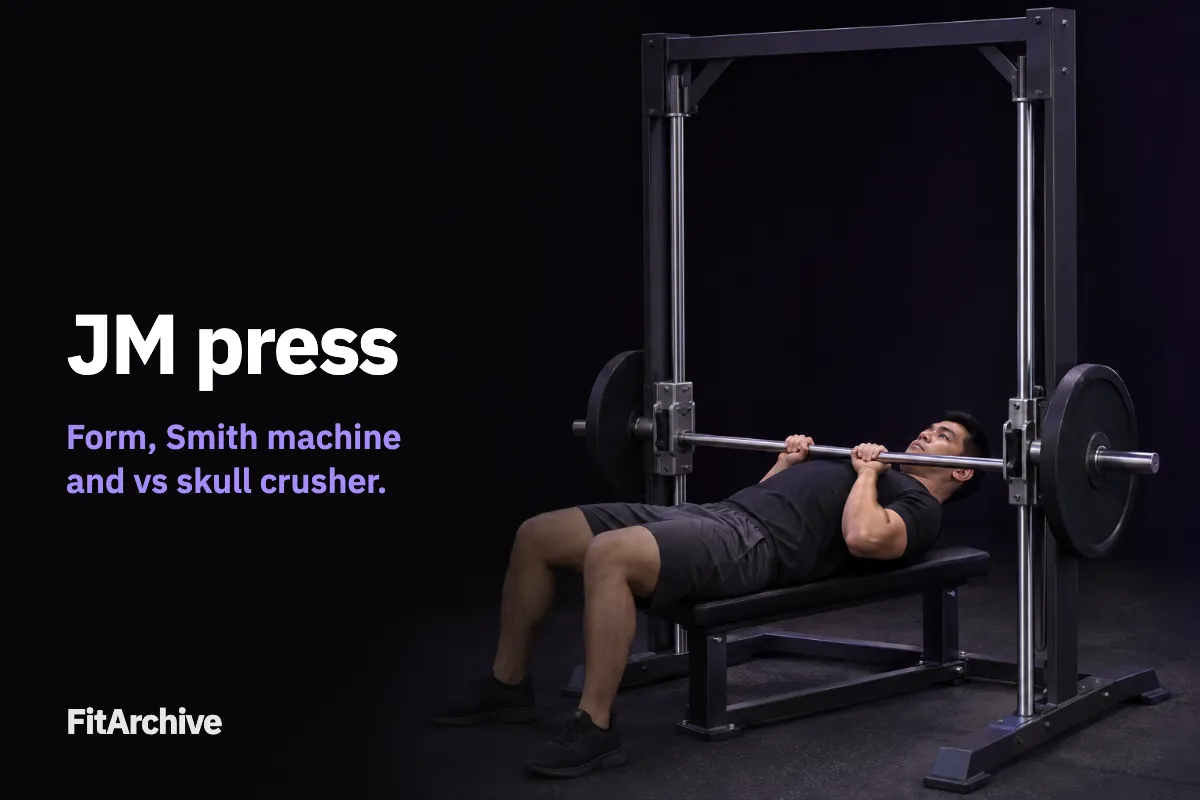
The JM press is a triceps exercise done lying on a flat bench with a shoulder-width grip. You lower the bar toward your upper chest by bending the elbows and letting them travel forward, then press it back up. It sits between a close-grip bench press, where the elbows tuck and the chest helps, and a skull crusher, where the upper arm stays vertical and only the elbow moves. It lets you load the triceps heavier than a skull crusher usually allows. No training study has tested it, so claims that it beats other triceps exercises are opinion, not data.
This guide shows the barbell and Smith machine setup, what the JM press trains, how it compares with the skull crusher and close-grip bench, and how to program it.
How to do a JM press with a barbell
The JM press as shown in FitArchive’s exercise library.
- Lie on a flat bench with your feet planted. Take a grip about shoulder width or slightly narrower, thumbs wrapped around the bar.
- Start with the bar over your shoulders, arms straight. Not over your face, as in a skull crusher.
- Lower by bending the elbows and letting them drift forward, toward your feet, without flaring them out. The bar travels down toward your upper chest, chin or throat area, depending on the version, while your forearms tilt. Many lifters keep the elbows fairly high so the triceps, not the chest, do the work.
- Stop when your forearms meet your upper arms, or just before. Keep the bar well clear of your neck.
- Press back up along the same path to straight arms. Do not bounce out of the bottom.
Use a spotter or safety arms, as you would for any bench pressing. The JM press is a pattern most people need a few sessions to groove, so start light.
Smith machine JM press
The Smith machine version is popular because the bar path is fixed, so you can focus on the elbows. Set it up with care:
- Set the safety stops just below the lowest point you can control. Check them with the empty bar first.
- Move the bench until the bar comes down over your upper chest when your elbows sit under it. Some Smith machines have an angled track, so test which way to face.
- Unhook the bar above your upper chest with a shoulder-width grip.
- Lower with the elbows forward and fairly close, and stop short of touching your body.
- Press back up and twist the bar into the hooks before letting go.
The Smith machine JM press in FitArchive’s exercise library.
What muscles does the JM press work?
The triceps do most of the work, because the elbow does most of the moving. The chest and front delts help, more than in a skull crusher and less than in a close-grip bench press, because the shoulder moves a little as the elbows travel forward and back.
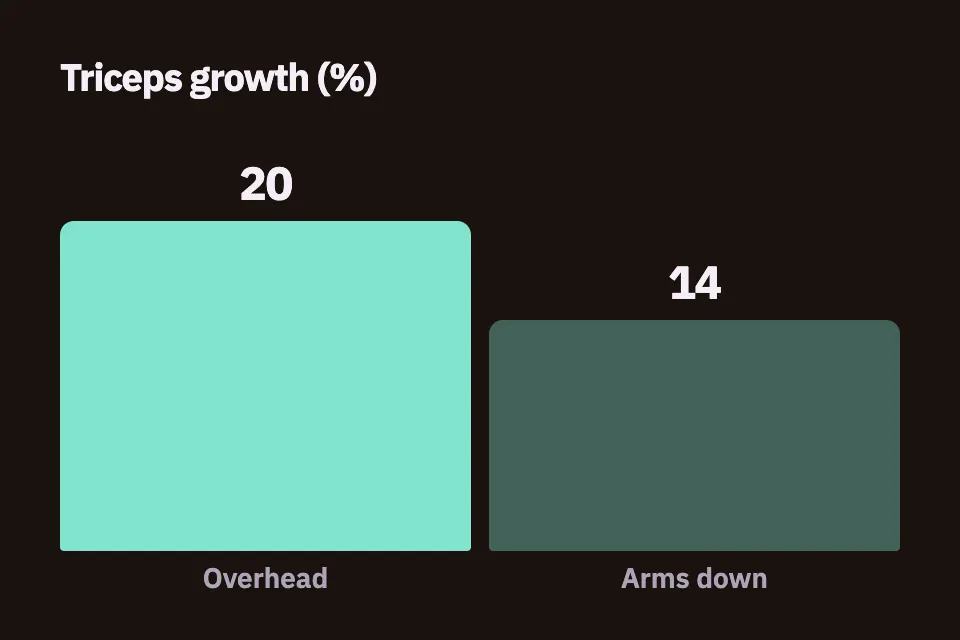
Is it good for the triceps long head? That claim is common but unsupported. In a JM press the upper arm stays near your side, not overhead. In a 2023 study of 21 adults, overhead cable extensions grew the long head by 28.5% over 12 weeks compared with 19.6% for the same exercise with the arms down. The JM press is closer to the arms-down position, so if the long head is your priority, an overhead extension has better evidence. See overhead triceps extension vs pushdown.
Is it a compound or isolation exercise? Both the elbow and shoulder move, so it sits in between. Treat it as mostly a triceps exercise with some chest and shoulder help. More on the categories in compound vs isolation exercises.
JM press vs skull crusher vs close-grip bench
| Close-grip bench press | JM press | Skull crusher | |
|---|---|---|---|
| Where the bar goes | To the lower chest | Toward the upper chest | Toward the forehead or behind the head |
| Elbows | Tucked, move a lot at the shoulder | Travel forward | Stay pointed up |
| Main muscles | Chest, triceps, front delts | Triceps, some chest and front delts | Triceps |
| Typical load | Heaviest | In between | Lightest |
Which is better? Nobody has run a training study on the JM press against either. The only head-to-head we found online is a student class project with one person, which cannot tell you anything general. Close-grip bench studies show that a narrower grip raises triceps activity a little and lowers the weight you can lift (2021, 2005), which is why the JM press is often described as a close-grip bench and skull crusher hybrid. But neither study tested the JM press itself.
Practical reasons to choose it: you want a heavier triceps exercise than a skull crusher and can do it comfortably. It is not a proven fix for elbows that ache during skull crushers. Practical reasons to skip it: it takes practice to learn, and a mistake can bring the bar near your neck.
Dumbbell JM press and alternatives
With dumbbells, a neutral grip lets you lower the dumbbells toward the front of your shoulders with the elbows forward. It is a reasonable home option, but it has not been studied either. Close alternatives:
- Close-grip bench press or Smith machine close-grip press, for more load and more chest.
- EZ-bar or dumbbell skull crusher, for more triceps isolation.
- Overhead cable or dumbbell extension, for the long head.
- Cable pushdown or a Tate press, if your elbows are sensitive.
For cable options with a cuff, see cable cuffs for lateral raises and triceps. For barbell vs Smith machine, see free weights vs machines.
Sets, reps and programming
- Reps: 6 to 12 is a sensible default. Very low reps put a lot of stress on the elbows.
- Sets: 2 to 3 hard sets, once or twice a week, alongside your other pressing.
- Effort: stop 1 to 2 reps short of failure on a barbell, closer on a Smith machine with safeties set.
- Warm-up: do one or two light sets first; elbows dislike a cold start. See warm-up sets.
- Load: expect to use a lot less than your close-grip bench press. On a light lift, a 2.5 kg jump is a big step, so add reps first using double progression.
Is the JM press bad for your elbows? There is no data either way. If your elbows ache, reduce the range, slow down, or swap to a cable exercise. Persistent pain is a reason to stop and get it checked. This is general information, not medical advice.
Track your JM press in FitArchive
FitArchive’s exercise library has both the JM press and the Smith machine JM press, each with a short demonstration clip, plus the close-grip bench press, skull crushers and the Tate press as alternatives. Log weight, reps and RIR for every set, and FitArchive suggests when you have earned more weight. The Progress screen shows your estimated one-rep max for the JM press and your weekly hard sets for the triceps. There is no separate dumbbell JM press entry yet, so add it as your own exercise if you use it.
Get FitArchive free on iPhone or Android. Logging and your full history are free, with no ads.