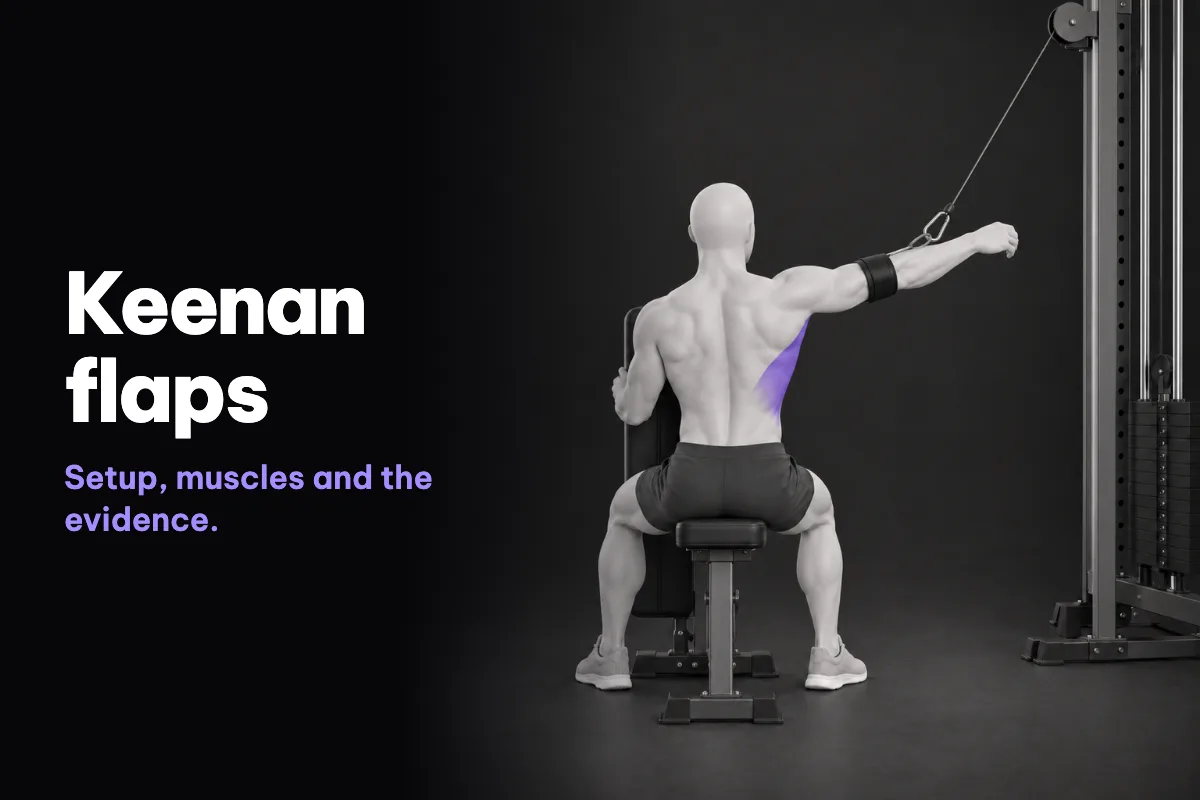
Keenan flaps are a single-arm cable exercise for the back. You wear a cuff on your upper arm or forearm instead of holding a handle, then drive your elbow down toward your side. They come in two versions, one pulling from the side and one from the front. We found no trial or muscle-activity study on them, so claims that they beat a lat pulldown aren’t backed by data. They’re a reasonable extra if you enjoy them and have the setup, but not something you need.
The two versions
The name is used for two setups. It mostly refers to the first.
| Version | In FitArchive | Setup | Movement |
|---|---|---|---|
| Frontal | Cuffed single-arm lat adduction | Pulley above head height, sitting sideways to the cable | Elbow comes down to your side |
| Sagittal | Cuffed single-arm lat pullover | Facing the stack | Arm moves from in front of you down to your side |
What do they train?
Mainly the lats, based on the arm’s path. Anatomy references also mention the teres major, rear delts and lower chest, and one critic argues the teres major does more of the work than the lats. None of this has been measured for this exercise, as far as we could find. FitArchive counts it as lat volume only, the same way it treats a cable pullover, rather than making up a split.
How to set up the frontal version
- Set the pulley above head height. Put an adjustable bench side-on to the cable with the back pad upright, and sit with your chest against the pad. This keeps your trunk from moving.
- Put the cuff above the elbow. Some lifters move it to mid-forearm as the load rises, because a cuff near the elbow can feel unstable when it gets heavy. Pick a spot and keep it.
- Sit with the working arm nearest the cable, reaching up, and let the cable pull your arm up into a stretch.
- Drive your elbow down to your side, keeping your chest on the pad, then let it rise back under control.
- Start light. The load won’t match your pulldown numbers.
The main complaints are practical. You often have to move a bench to the cable, and the cuff can bruise. Pad it or move it if so, and stop if the discomfort stays. This article is general information, not medical guidance.
Are they better than a lat pulldown?
Nobody has tested that. What we can say is narrower:
- No trial or muscle-activity study on the exercise turned up in our search.
- The case for them is reasoning: no grip limit, one arm at a time and a long reach at the top.
- Popularity isn’t evidence. They’ve been widely posted since mid-2025, and plenty of experienced lifters are sceptical.
A pulldown or row you can load heavily and progress for months is still a sound base. If you add flaps, count them as lat sets and don’t remove the work you know is progressing. Our guide to weekly sets covers how to keep an eye on total volume.
How to log them
Log each side as you would any single-arm exercise, and keep the cuff position and pulley height the same so your numbers stay comparable. Treat the frontal and sagittal versions as two exercises.
Example log (invented numbers, not a recommendation):
| Week | Exercise | Sets | Note |
|---|---|---|---|
| 1 | Cuffed single-arm lat adduction | 15 kg × 12, 11 at 1 RIR | Cuff above elbow, pin 12 |
| 2 | Cuffed single-arm lat adduction | 15 kg × 12, 12 at 1 RIR | Same setup, fair to compare |
| 3 | Cuffed single-arm lat adduction | 17.5 kg × 12, 12 at 1 RIR | Cuff on forearm, new starting point |
Common mistakes
- Skipping the support. Without a pad, it’s easy to twist and lean. Bracing keeps the work on the arm’s path. No trial has tested this for growth; it’s practical reasoning.
- Twisting the torso to move more weight. The elbow should move, not your ribcage.
- Changing the cuff position each week. It changes the lever, so the numbers stop being comparable.
- Replacing all your pulldowns and rows. There’s no evidence to justify it.
- Chasing the feeling. A strong feeling in the muscle isn’t proof of more growth.
Logging flaps in FitArchive
Search “Keenan flap” in FitArchive to find both versions under their plain names, with a guide and a short clip. They count toward your lat volume like other back exercises. For cuffs in general, see cable cuffs for lateral raises and triceps. You can try it with sample data in the demo.