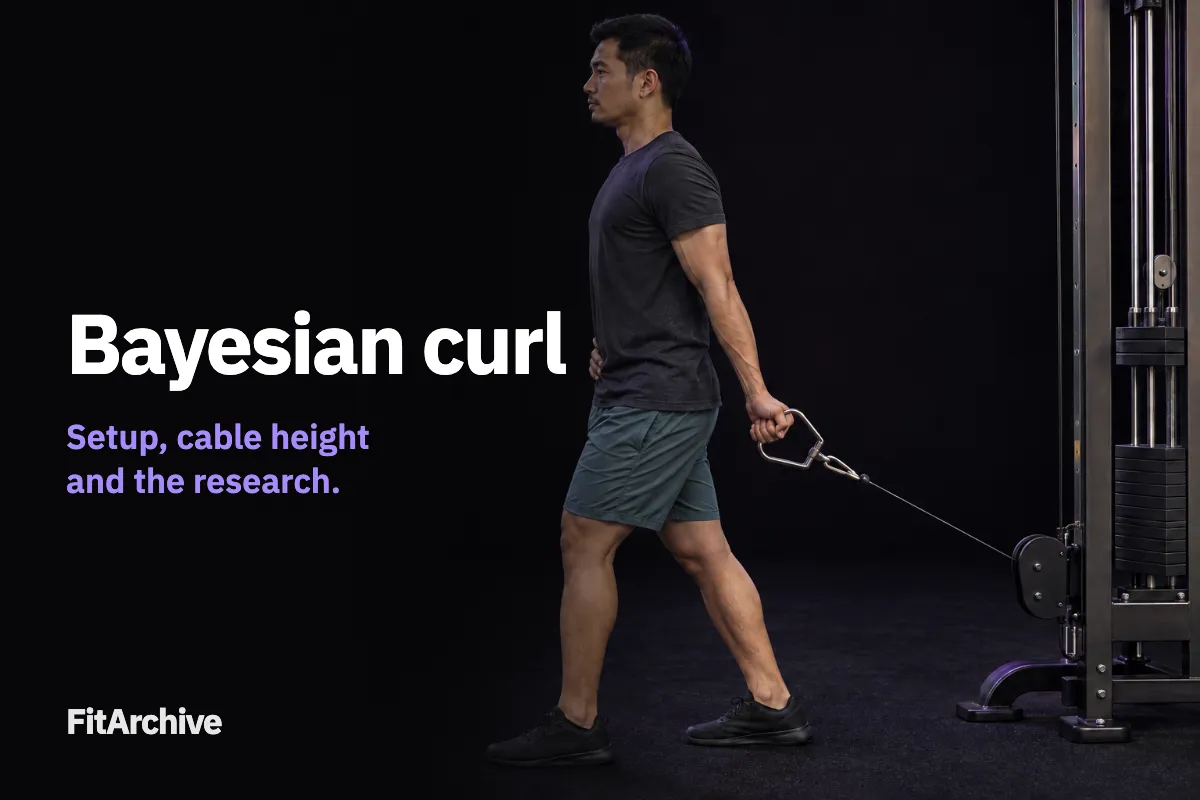
The Bayesian curl is a one-arm cable curl done facing away from a low pulley. You step forward until the cable pulls your upper arm slightly behind your body, then curl while keeping the elbow back. That puts the biceps under load in a stretched position at the start of each rep. A 10-week trial in 15 men found it built the biceps about as well as a preacher cable curl, and a 2026 trial found no meaningful difference from a cable curl with the arm at your side. It is a good curl, not a magic one.
This guide covers the setup, the cable height, what it trains, what the research shows, and how it compares with the preacher curl and the incline dumbbell curl. The name has nothing to do with the movement itself. You may also see it called a face-away cable curl or behind-the-body cable curl.
How to do a Bayesian curl
The Bayesian cable curl as shown in FitArchive’s exercise library.
- Set the pulley low. Attach a single D-handle at the lowest or a low setting. Most guides agree on low; nothing has tested an exact height. A low pulley makes the bottom of the rep, where the arm is behind you, the part with load.
- Face away and step forward. Hold the handle in one hand and walk forward into a split stance until the cable pulls your upper arm slightly behind your torso. About 20 to 45 degrees behind the body is enough. If the front of your shoulder complains, stand a little closer to the stack.
- Curl with the elbow fixed. Keep the upper arm at that angle and curl the handle toward your shoulder, palm up.
- Lower slowly to a straight elbow. Let the arm go back behind your hip until the elbow is straight. That stretched bottom is the point of the exercise, so do not cut it.
- Do all reps on one arm, then switch. Put your free hand on your hip or hold the frame for balance.
Common mistakes:
- Letting the elbow drift forward as you curl, which turns the top of the rep into a front raise.
- Standing so far forward that your shoulder is cranked back.
- Leaning the torso to swing the weight up.
- Doing only the top half of the rep.
- Going so heavy that the elbow never fully straightens.
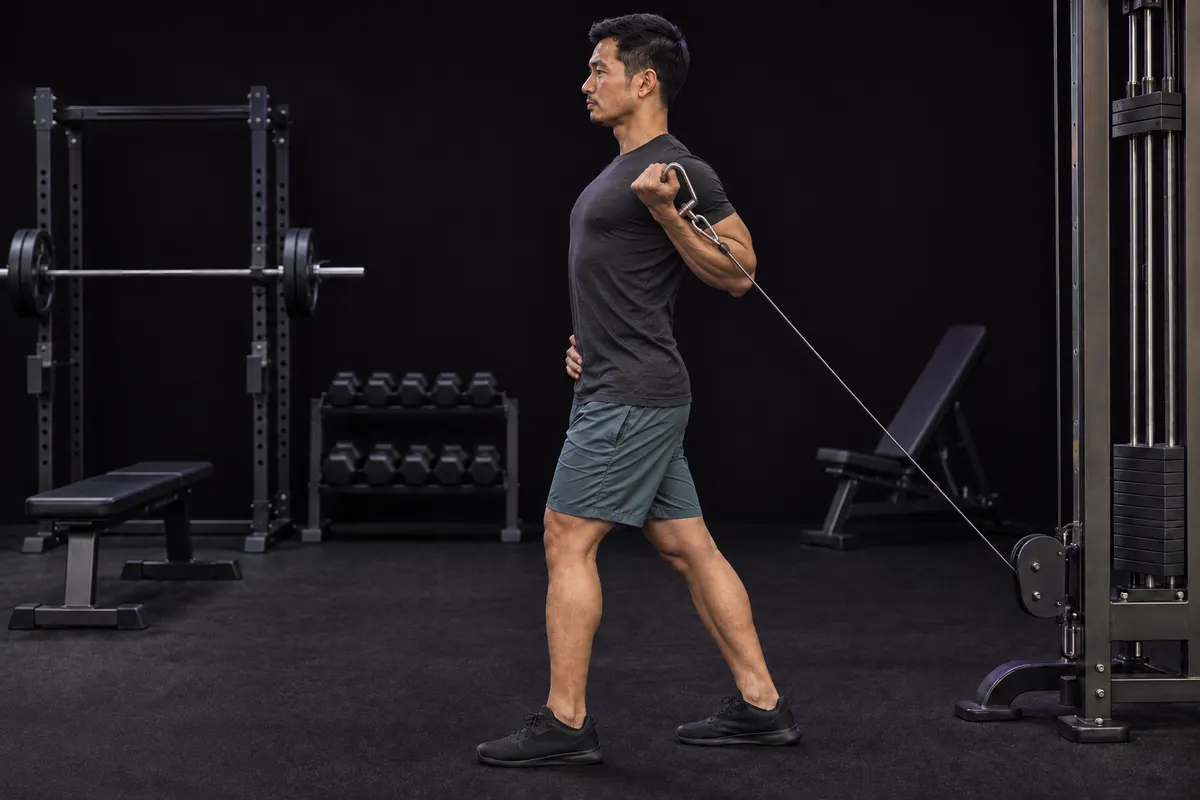
The top of the rep: the elbow stays behind the body while the forearm curls up.
What muscles does the Bayesian curl work?
The biceps do most of the work, with the brachialis and the forearm muscles that bend the elbow helping. In the direct trial below, the brachialis grew by about 8% alongside the biceps.
Many pages say the Bayesian curl “targets the long head” of the biceps. The idea comes from anatomy: the long head crosses the shoulder, so it is lengthened when the arm is behind the body. That is reasonable, but no study has measured the long head on its own after Bayesian curls. Shoulder position changes the long head’s length, but extra long-head growth from it is unproven.
What does the research say?
Bayesian curl vs preacher curl: the direct trial
A 2025 study trained 15 young men twice a week for 10 weeks. Each man did a Bayesian cable curl with one arm (shoulder extended about 50 degrees) and a preacher cable curl with the other (shoulder flexed about 50 degrees). Both used cables, so the resistance was similar through the rep. They did 3 to 5 sets of 8 to 12 reps.
| Result after 10 weeks | Preacher cable curl | Bayesian cable curl |
|---|---|---|
| Biceps thickness, by site | +6% to +7% | +9% |
| Brachialis thickness | +10% | +8% |
| One-rep max in the trained curl | +28% | +37% |
None of the differences were statistically significant. The authors concluded that shoulder angle did not seem to change biceps growth or strength when the resistance profile was matched. The Bayesian numbers are slightly higher, but with 15 people that could easily be chance.
Limits worth knowing: it was short, it used ultrasound at three sites rather than whole-muscle MRI, it included only young men, and it compared two cable curls, not a Bayesian curl with a dumbbell or EZ-bar preacher curl.
Incline vs preacher curls with dumbbells
The same question has been tested with dumbbells. An incline dumbbell curl also puts the arm behind the body, while a preacher curl puts it in front.
- A 2025 trial in 63 young women found the incline curl grew the upper part of the elbow flexors more and the preacher curl grew the lower part more. Each group got stronger mostly on its own exercise.
- A 2026 MRI study in 21 untrained adults found the incline curl grew the biceps a little more (+22.1% vs +18.9%), while the preacher curl grew the brachialis and brachioradialis more. Total elbow flexor growth was the same (+17.6% vs +19.2%, not significant).
So the arm angle seems to shift which muscle or region grows a bit more, not how much the arm grows in total.
Muscle activity is not the same as growth
An exploratory 2025 study in 11 people found higher biceps EMG during a dumbbell curl than a Bayesian curl at 80% of each exercise’s max. The training trials compared different exercises, so they cannot rank those two directly, but short-term muscle activity is generally a weak guide to long-term growth.
Why the stretched start might matter
There is growing evidence that training a muscle at long lengths can help growth, but a 2026 review argues it depends on there being real load at the long length. A cable from behind gives that load at the bottom of a Bayesian curl. More on this in lengthened partials and long muscle length. For the triceps, the long-length idea has a clearer result: overhead extensions grew more than pushdowns in our triceps comparison.
Bayesian curl vs incline dumbbell curl
Both put the arm behind your body. The difference is where the exercise is hardest.
| Bayesian cable curl | Incline dumbbell curl | |
|---|---|---|
| Arm position | Behind the body | Behind the body |
| Load at the bottom (stretched) | Yes, the cable pulls back | Very little: the forearm hangs straight down |
| Load at the top | Moderate | Highest mid-rep |
| Equipment | Cable stack | Dumbbells and an incline bench |
| Loading steps | Stack plates, often 2.5 to 5 kg | Dumbbell pairs |
If you have no cable, the incline dumbbell curl is the closest free-weight option. A band anchored low behind you is another. More on choosing between cables and free weights in free weights vs machines.
Sets, reps and where to put it
- Reps: 8 to 15 per arm works well. Most people find the stretched start hard to control below about 8 reps.
- Sets: 2 to 3 per arm in a session that already has a row or pulldown is plenty for most lifters.
- Effort: stop about 0 to 2 reps short of failure.
- Placement: pull days, upper days or arm days. It pairs well with a curl that loads the arm in front, such as a preacher curl, if you want variety.
Cable stacks jump in coarse steps, so add reps before weight. Double progression shows how: stay at one weight until every set reaches the top of your rep range, then move up one plate.
Is it enough for the biceps on its own? It can be, if your weekly sets are enough. Rows and pulldowns also give the biceps some work. The weekly sets guide explains how to count them.
Questions people ask
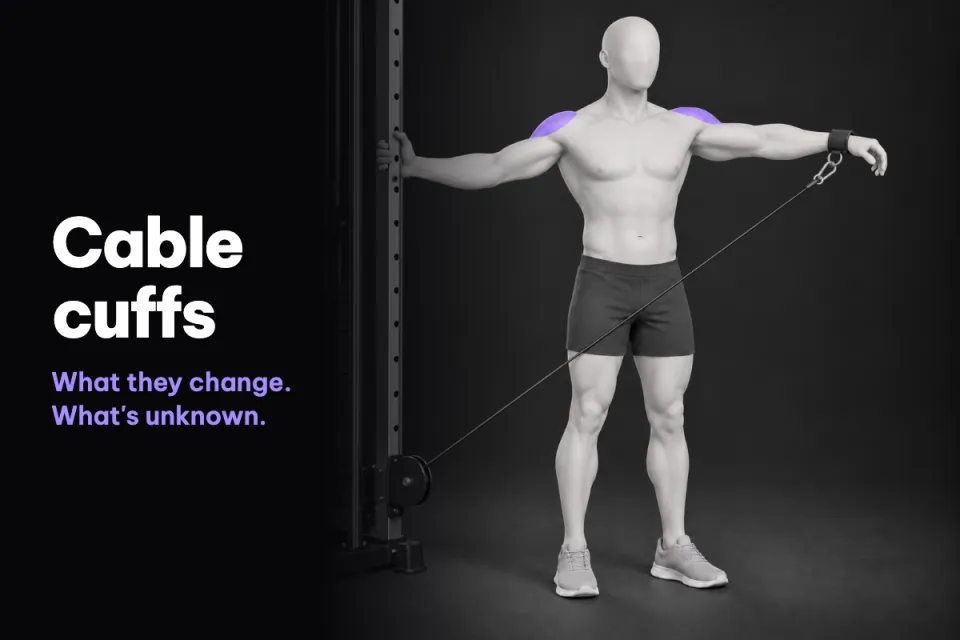
Can I do it with a cuff instead of a handle? Yes. A cuff around the wrist takes grip out of it. See our guide to cable cuffs.
Why does my forearm or the front of my shoulder hurt? Pain can have many causes. Setup and load are common ones, so try standing closer to the stack and lightening the weight, and stop if the pain stays. This is general information, not medical advice.
Is it better than a regular cable curl? Probably not for size. A 2026 trial had 24 untrained men train one arm with cable curls at the shoulder’s furthest extension and the other with the arm at the side, for 10 weeks. Both arms grew by about 7 to 9%, with no meaningful difference when the resistance profile and range of motion were matched.
Track your Bayesian curls in FitArchive
FitArchive has the Bayesian cable curl in its exercise library with a short demonstration clip, plus the incline dumbbell curl, the preacher curl and the single-arm cable curl as alternatives. Log each set’s weight, reps and RIR, and FitArchive suggests when you have earned the next plate. The Progress screen shows your estimated one-rep max per exercise and weekly hard sets for the biceps, so you can see whether the curl is moving.
Get FitArchive free on iPhone or Android. Logging and your full history are free, with no ads.