Three new studies answer three common gym questions. In trained lifters, a fixed rest between sets of about 2 minutes built as much muscle and strength over 8 weeks as resting for as long as each person liked, and sessions finished about 22 minutes sooner. In adults aged 55 and over, a vegetarian diet plus training still built muscle, but people ate less protein than on an omnivorous diet and gained less leg and arm muscle on average. And in a small 16-week trial, eating 3.2 g of protein per kg of body weight a day showed no statistically clear difference in kidney blood markers compared with 1.6 g/kg.
This is FitArchive’s research update. For each paper we say what was tested, what it found, how much weight to give it, and what, if anything, to change. We read the abstracts on PubMed; where a detail was not reported there, we say so rather than guess. Two of these papers appeared online in early November 2026; the third was published online in September and appears in the November issue of its journal.
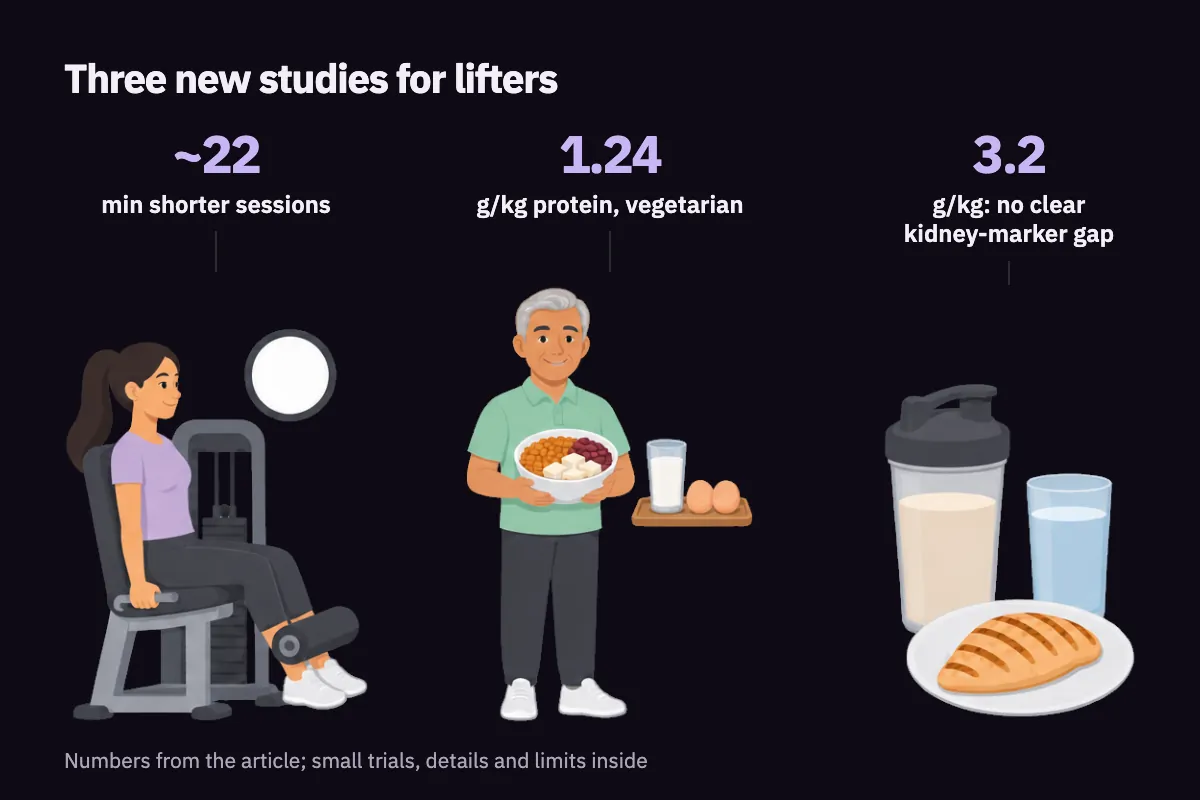
Three studies: how long to rest, plant-based protein, and very high protein intakes.
Study 1: rest between sets, a timed 2 minutes vs as long as you like
The paper. Mohan and colleagues, International Journal of Sports Medicine, published online on 6 November 2026. Randomised trial.
What they did. 40 resistance-trained adults were randomised to rest for as long as they wanted between sets (self-selected group, 21 people) or for a fixed rest of about 2 minutes (fixed group, 19 people). Both groups did 8 weeks of supervised lower-body training: 4 sets of 8 to 12 reps of squats, leg extensions, standing calf raises and seated calf raises. The researchers measured muscle thickness with ultrasound, dynamic and isometric strength, muscular endurance, session length and session RPE (how hard the whole session felt). The abstract does not say how long the self-selected group actually rested on average.
What they found.
| Result after 8 weeks | Self-selected rest | Fixed ~2-minute rest |
|---|---|---|
| Muscle thickness, strength, endurance | Improved | Improved, no meaningful difference |
| Average session length | 78.5 min | 56.0 min |
| Session RPE (how hard it felt) | 8.1 | 8.2 |
The overall effect of the rest method was trivial for muscle growth (−0.1 standard deviations, 95% credible interval −0.2 to 0.0) and for performance (0.0, −0.3 to 0.3). The fixed group finished its sessions about 29% faster.
How much weight to give it: moderate. It is a randomised trial in trained people, which is the group most readers belong to, and it measured both size and strength. But it had 40 participants, lasted 8 weeks, and trained only the legs. It also compared one fixed rest (about 2 minutes) with free choice, so it does not tell us whether 1 minute or 4 minutes would differ.
How it fits. Earlier work found that very short rests of about a minute can cost growth and strength, mostly because they cut the reps you manage on later sets; a 2024 meta-analysis found little extra benefit beyond about 90 seconds. This trial adds that letting people rest as long as they like did not add anything over about 2 minutes, but it did add time.
What it means. For muscle and strength in this kind of training, resting about 2 minutes between sets looks like a good default that does not cost results and keeps sessions shorter. If you often lose track and rest 4 or 5 minutes, a timer is a free way to shorten your workout. Very heavy low-rep sets were not tested here; longer rests there are still reasonable. Our guide on how long to rest between sets covers the full picture.
Study 2: vegetarian vs omnivorous diet with strength training in adults over 55
The paper. van Oppenraaij, Weijs and Verlaan, American Journal of Clinical Nutrition, November 2026 issue (online 22 September 2026). Randomised non-inferiority trial (the IMPACT trial).
What they did. 108 adults with a median age of 66 (58% women) all did a 12-week resistance training programme, three sessions a week. They received dietary counselling for either a lacto-ovo vegetarian diet (at least 60% of protein from plants) or an omnivorous diet (at least 60% from animal foods), and both groups chose their own foods with a target of at least 1.2 g of protein per kg of body weight a day. The main outcomes were protein intake (3-day food records) and appendicular muscle mass (arm and leg muscle, measured by DXA). The trial asked whether the vegetarian diet was “not worse” than the omnivorous one within set margins.
What they found.
| Result after 12 weeks | Vegetarian | Omnivorous |
|---|---|---|
| Protein eaten (g/kg/day) | 1.24 | 1.58 |
| Share of protein from the target source | 76% plant | 67% animal |
| Change in arm and leg muscle | +0.38 kg | +0.66 kg |
| Leg press strength, chair-stand test | Improved | Improved, no difference between groups |
Both groups gained muscle and strength. The vegetarian group ate 0.33 g/kg/day less protein on average (95% CI −0.49 to −0.17), and its muscle gain was 0.33 kg smaller (95% CI −0.69 to 0.03). The trial could not show that the vegetarian diet was “not worse”: the muscle result was close but uncertain, and the protein shortfall was clear.
How much weight to give it: moderate. It is a well-sized randomised trial with DXA, in older adults, a group where keeping muscle matters a lot. But people chose their own food, so the two diets differed in total protein as well as protein source. The study cannot tell whether the smaller gain came from plant protein itself or simply from eating less protein.
How it fits. A 2023 trial in young adults found similar muscle growth on vegan and omnivorous diets when both groups ate a high, matched amount of protein. Read together, the practical lesson is that the protein total is what is easy to miss on a plant-based diet.
What it means. Vegetarian lifters, including older ones, can build muscle. If you eat mostly plants, track your protein for a few weeks rather than assuming you hit your target, and use foods such as eggs, dairy, tofu, tempeh, lentils and beans across the day. See how much protein per day to build muscle and strength training over 50.
Study 3: 3.2 g/kg protein a day and kidney blood markers
The paper. Bagheri and colleagues, Journal of the International Society of Sports Nutrition, published online on 3 November 2026. Randomised trial, exploratory analysis.
What they did. 48 resistance-trained men (average age 26) were randomised in a 2 × 2 design: 16 weeks of resistance training or concurrent training (strength plus endurance), four sessions a week, while eating either 1.6 or 3.2 g of protein per kg of body weight a day. 44 completed the study. The team measured blood markers used to judge kidney function: blood urea nitrogen (BUN), the BUN/creatinine ratio, cystatin C, and estimated glomerular filtration rate (eGFR) from three standard equations.
What they found.
- There was no statistically significant difference in how any kidney marker changed between the 3.2 and 1.6 g/kg groups (all p ≥ 0.182), whatever the type of training.
- In the 1.6 g/kg groups, nothing changed significantly.
- Within the 3.2 g/kg groups, BUN and cystatin C rose and eGFR estimates fell. The authors call these within-group changes descriptive, because the between-group comparison was not significant.
- The authors say the sample was too small to rule out clinically meaningful differences, and that larger studies are needed.
How much weight to give it: low. It is small, labelled exploratory, in healthy young men only, and kidney markers are indirect. A rise in BUN on a very high-protein diet is expected, because BUN reflects protein breakdown; it does not by itself mean kidney damage. The small cystatin C rise and eGFR fall are less easily explained by diet alone, which is why the authors call for larger studies.
How it fits. A 2018 meta-analysis found little extra muscle-growth benefit above about 1.6 g/kg a day, so 3.2 g/kg is double what most lifters need. This trial adds that in healthy young men it did not produce a clear difference in kidney markers over 16 weeks, but it cannot prove such intakes are risk-free.
What it means. For muscle, around 1.6 g/kg a day remains a sensible target, and going far beyond it buys little. This study is not a reason to eat 3.2 g/kg. If you have kidney disease, diabetes or high blood pressure, or your doctor monitors your kidney function, talk to them before changing your protein intake.
What we would change
| If you currently… | Based on these papers, consider… |
|---|---|
| Rest “until you feel ready”, often 4 minutes or more | A timer around 2 minutes for sets of 8–12 reps; it saved about 22 minutes a session in this trial |
| Eat mostly plants and guess your protein | Logging food for 2–3 weeks to check you really reach your target |
| Push protein to 3 g/kg or more “to be safe” | Aiming near 1.6 g/kg and spending the extra on food you enjoy |
How we judge new research
- Design first: randomised trials and meta-analyses over single observations.
- Who was studied: results in young men, older adults or untrained people do not automatically transfer to everyone.
- What was measured: blood markers and ultrasound at one site are useful but partial pictures.
- Peer review status: preprints are labelled as such; all three papers here are peer reviewed.
- Fit with the existing evidence: we say whether a paper confirms, refines or challenges what was already known.
This article summarises research for general education. It is not medical advice or a personal training or diet prescription.
Track rest, sets and protein in FitArchive
FitArchive logs every set’s weight, reps and reps in reserve, and its rest timer starts by itself after each set, so a steady rest is easy to keep. The same app logs your food, so you can see your daily protein next to your training. Try it with sample data in the demo.