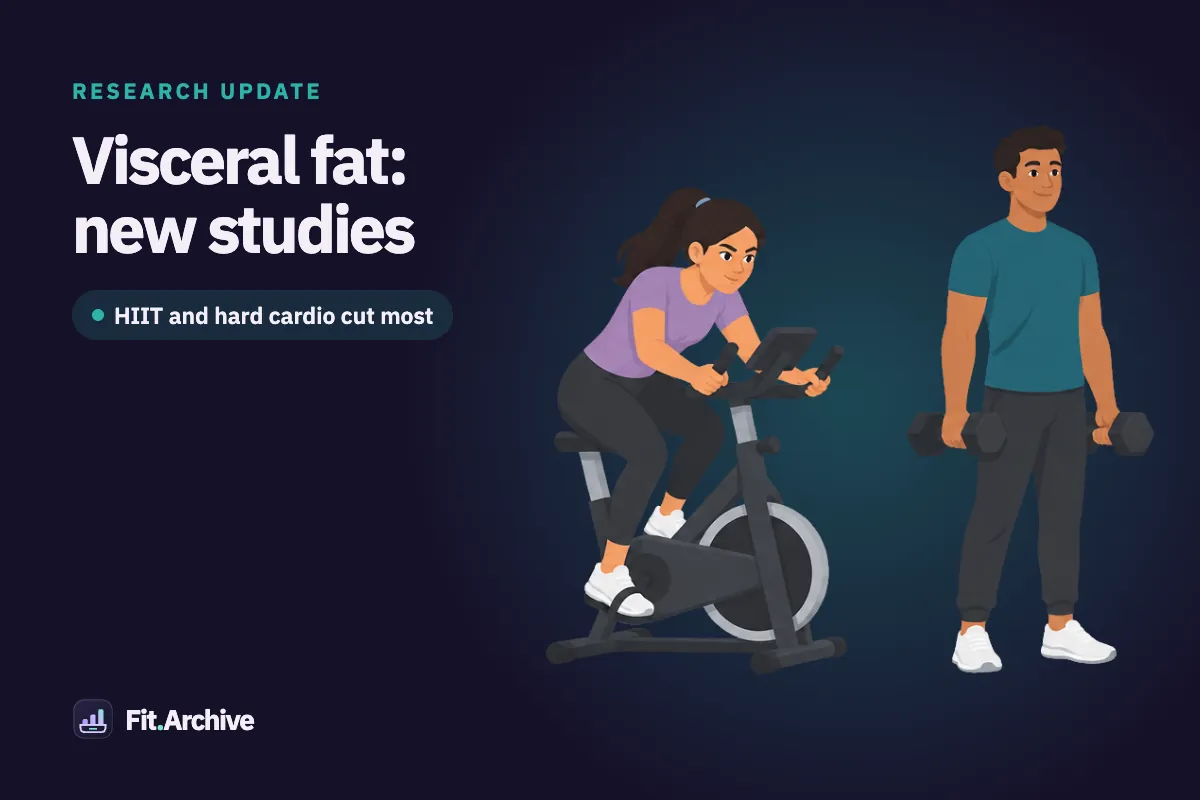
What is the best exercise for visceral fat, the deep belly fat around the organs? A new network meta-analysis of 78 reports and 4,930 people with overweight or obesity found that vigorous aerobic exercise and high-intensity interval training (HIIT) gave the largest estimated reductions, but combined training, moderate cardio and resistance training all reduced it too. A preprint on intermittent fasting, keto and low-carb diets found clear drops in weight and fat but no clear answer on lean mass. And a small trial found a new creatine product raised blood creatine no differently from plain creatine monohydrate.
This is FitArchive’s research update. For each paper we say what was tested, what it found, how much weight to give it, and what, if anything, to change. We read the abstracts; where a detail was not reported there, we say so rather than guess. All three appeared online between 4 and 10 November 2026.
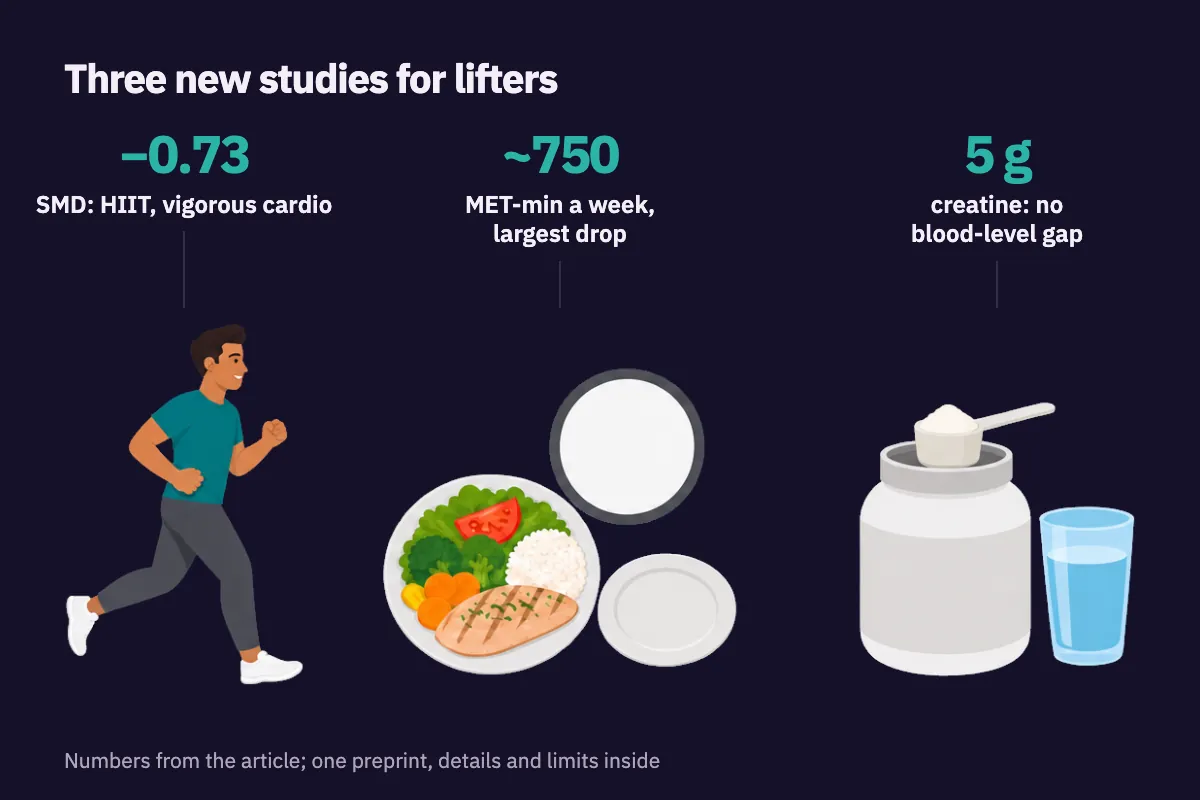
Three studies: exercise and visceral fat, diet type and lean mass, and a new creatine form.
Study 1: the best exercise for visceral fat, and how much
The paper. Deng and colleagues, Obesity Reviews, published online on 10 November 2026. Systematic review with pairwise, network and dose-response meta-analyses of randomised controlled trials.
What they did. The authors searched six databases through October 2025, with an extra search on 18 August 2026, and pooled 78 reports with 4,930 participants. Participants had an average age of 43 and an average body mass index of 30.7; 58.4% were women. A network meta-analysis lets trials that compared different things be compared on one scale. Results are given as a standardised mean difference (SMD): the effect in standard-deviation units, where more negative means more visceral fat lost compared with no exercise.
What they found.
| Exercise type vs no exercise | Effect on visceral fat (SMD) | 95% CI |
|---|---|---|
| Vigorous aerobic exercise | −0.73 | −0.96 to −0.51 |
| High-intensity interval training (HIIT) | −0.73 | −0.94 to −0.53 |
| Combined aerobic and resistance training | −0.61 | −0.81 to −0.41 |
| Moderate to vigorous aerobic exercise | −0.53 | −0.67 to −0.39 |
| Resistance training | −0.50 | −0.72 to −0.28 |
On dose, total weekly exercise showed a U-shaped relationship with visceral fat loss. The benefit was statistically clear between about 99 and 1,225 MET-minutes a week, the model estimated that about 440 MET-minutes a week was needed for what the authors call a substantial clinical benefit, and the largest predicted reduction was at about 750 MET-minutes a week.
MET-minutes multiply an activity’s intensity in METs (1 MET is roughly the energy you use sitting still) by the minutes you do it. As arithmetic only: 750 MET-minutes could be 125 minutes a week of a 6-MET activity, or 150 minutes of a 5-MET activity. The abstract does not translate the dose into specific workouts.
How much weight to give it: moderate to high. It pools many randomised trials and nearly 5,000 people, and the outcome is visceral fat itself, not body weight. But the participants were adults with overweight or obesity, not lean lifters; the abstract does not report how the trials measured visceral fat, how long they lasted, or whether diets were controlled; and network rankings carry more uncertainty than head-to-head trials. The confidence intervals of all five types overlap, so the ranking is not a strong verdict that cardio beats lifting. Our reading of the U shape: fewer trials test very high weekly doses, so the upper end is uncertain rather than proof that more exercise stops working.
How it fits. It agrees with what our article on spot reducing belly fat found: crunches do not choose where fat comes off, but whole-body exercise does reduce visceral fat, and both cardio and lifting count.
What it means. If visceral fat is your concern, any regular training helps, and harder cardio or intervals gave the largest average effect here. If you already lift, adding some vigorous cardio or intervals is a reasonable step; you do not need to stop lifting, which also builds strength and muscle that cardio does not. Very large weekly volumes were not shown to add more.
Study 2: intermittent fasting, keto and low-carb diets, and lean mass
The paper. de Sousa Siqueira and colleagues, Preprints.org, posted on 4 November 2026. Preprint, not peer reviewed. A meta-analysis built from another systematic review.
What they did. Rather than collecting trials themselves, the authors transcribed effect estimates from the supplementary forest plots of an earlier systematic review of controlled diet trials in adults with overweight or obesity. The abstract does not name that source review or the number of participants, and says the original manuscript gives inconsistent participant totals.
What they found.
| Outcome | Number of estimates | Effect (SMD) | 95% CI | Heterogeneity (I²) |
|---|---|---|---|---|
| Body weight or BMI | 21 | −0.97 | −1.07 to −0.86 | 79.66% |
| Total fat mass | 9 | −0.94 | −1.06 to −0.81 | 27.86% |
| Visceral or central fat | 8 | −0.80 | −0.98 to −0.63 | 74.16% |
| Lean or muscle mass | 11 | −0.08 | −0.48 to 0.31 | 96.48% |
The diets reduced weight and fat. For lean mass the pooled effect was close to zero with a very wide interval, and heterogeneity of 96% means the individual results disagreed sharply. The authors call the lean-mass result inconclusive.
How much weight to give it: low. It is a preprint, it re-analyses someone else’s summary data rather than the trials themselves, the abstract does not say which comparisons the diets were tested against, and the authors themselves flag inconsistent counts and uncertain standard errors in the source. It does not tell you whether fasting or keto protects or costs muscle.
How it fits. It does not change the existing picture: fat loss follows a sustained calorie deficit, and the diet style that helps you keep that deficit is largely a matter of preference. This paper cannot answer whether a given diet style is better or worse for muscle.
What it means. If you are cutting, pick the eating pattern you can stick to. Do not assume any diet style protects muscle on its own; the habits covered in how to keep muscle while cutting, such as continuing to lift, eating enough protein and not losing weight too fast, matter more than the label on the diet.
Study 3: a new creatine formulation vs creatine monohydrate
The paper. DelBiondo and colleagues, Journal of the International Society of Sports Nutrition, published online on 9 November 2026. Randomised, double-blind, crossover trial.
What they did. 17 healthy, recreationally active adults (8 men and 9 women, average age 22) took a single 5 g dose of either standard creatine monohydrate or a newer creatine monohydrate product (OptiCreatine) after an overnight fast, on two separate visits. Blood was drawn at the start and over the following 5 hours to measure serum creatine, and stomach and gut symptoms were recorded with questionnaires.
What they found.
- Serum creatine did not differ between the two products at any time point, in the whole group (p = 0.707), in men (p = 0.318) or in women (p = 0.996).
- Peak level, time to peak, absorption and elimination rates and total exposure (area under the curve) were all similar, with no differences by sex.
- Gut symptoms were low and similar with both products.
How much weight to give it: low for buying decisions. It is a well-controlled design, but it tested one dose, in 17 people, and measured only blood creatine for 5 hours. It did not measure muscle creatine, strength or muscle growth over weeks, and the abstract does not state who funded the study.
How it fits. Creatine monohydrate is the form with by far the most research on safety and results, as covered in our creatine guide. This trial found the newer product behaved the same in the blood after one dose; it did not show any advantage.
What it means. If plain monohydrate suits you, there is no reason here to switch. If monohydrate upsets your stomach, this trial does not show the newer product is easier on the stomach, because symptoms were low with both. Price and third-party testing are reasonable tie-breakers.
What we would change
| If you currently… | Based on these papers, consider… |
|---|---|
| Lift but do no cardio, and want to reduce belly fat | Adding some vigorous cardio or intervals alongside lifting |
| Do hours of exercise a week hoping for more visceral fat loss | Knowing the benefit did not keep growing at very high weekly doses |
| Chose fasting or keto to protect muscle | Choosing the diet you can sustain, and keeping lifting and protein |
| Pay extra for a “better absorbed” creatine | Plain creatine monohydrate; this trial found no blood-level difference |
How we judge new research
- Design first: randomised trials and meta-analyses over single observations.
- Who was studied: results in adults with obesity or in young active adults do not automatically transfer to every lifter.
- What was measured: blood levels after one dose, or fat on a scan, are partial pictures.
- Peer review status: Study 2 is a preprint and is labelled as such; Studies 1 and 3 are peer reviewed.
- Fit with the existing evidence: we say whether a paper confirms, refines or challenges what was already known.
This article summarises research for general education. It is not medical advice or a personal training or diet prescription. If you have a medical condition, take medication or are planning a large weight change, talk to a doctor first.
Track training, food and your waist in FitArchive
FitArchive logs each set’s weight, reps and reps in reserve, and logs meals with daily calories and protein. Record one body weight reading a day to see a smoothed weight trend with the change per week, and add waist measurements in centimetres, a simple way to follow belly fat at home. Try it with sample data in the demo.