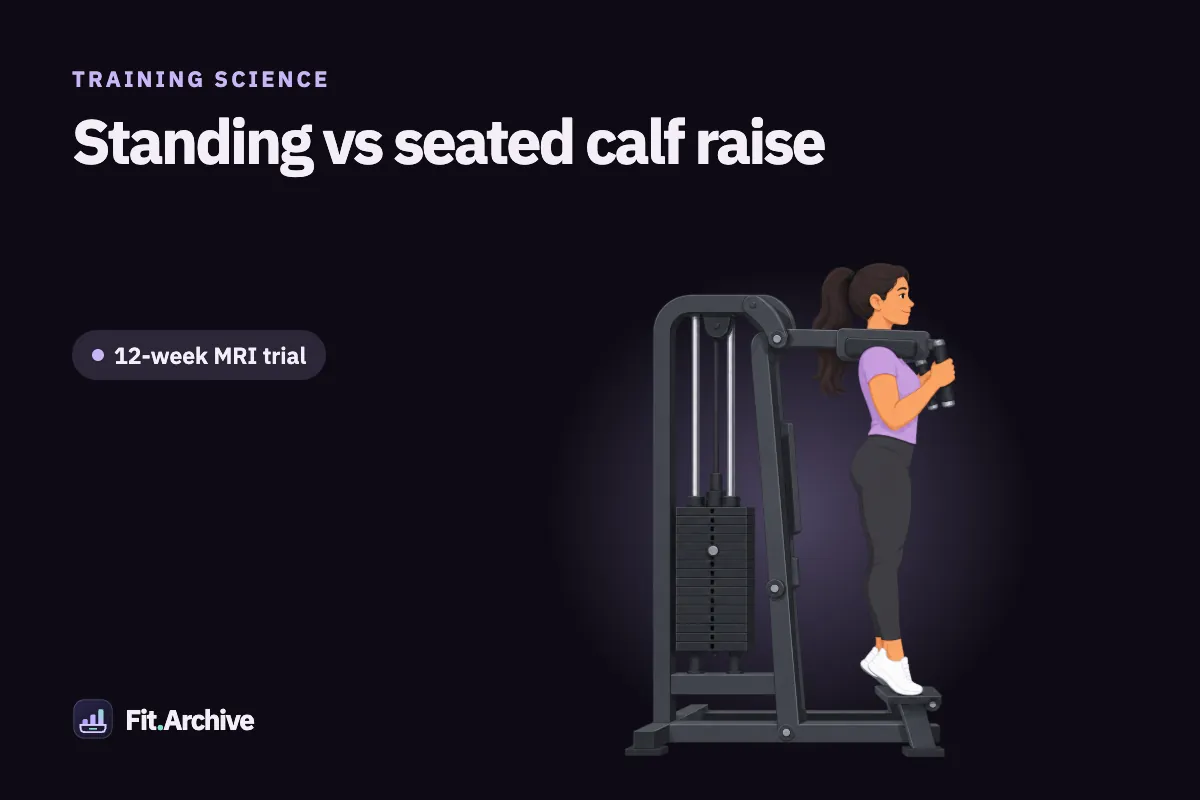
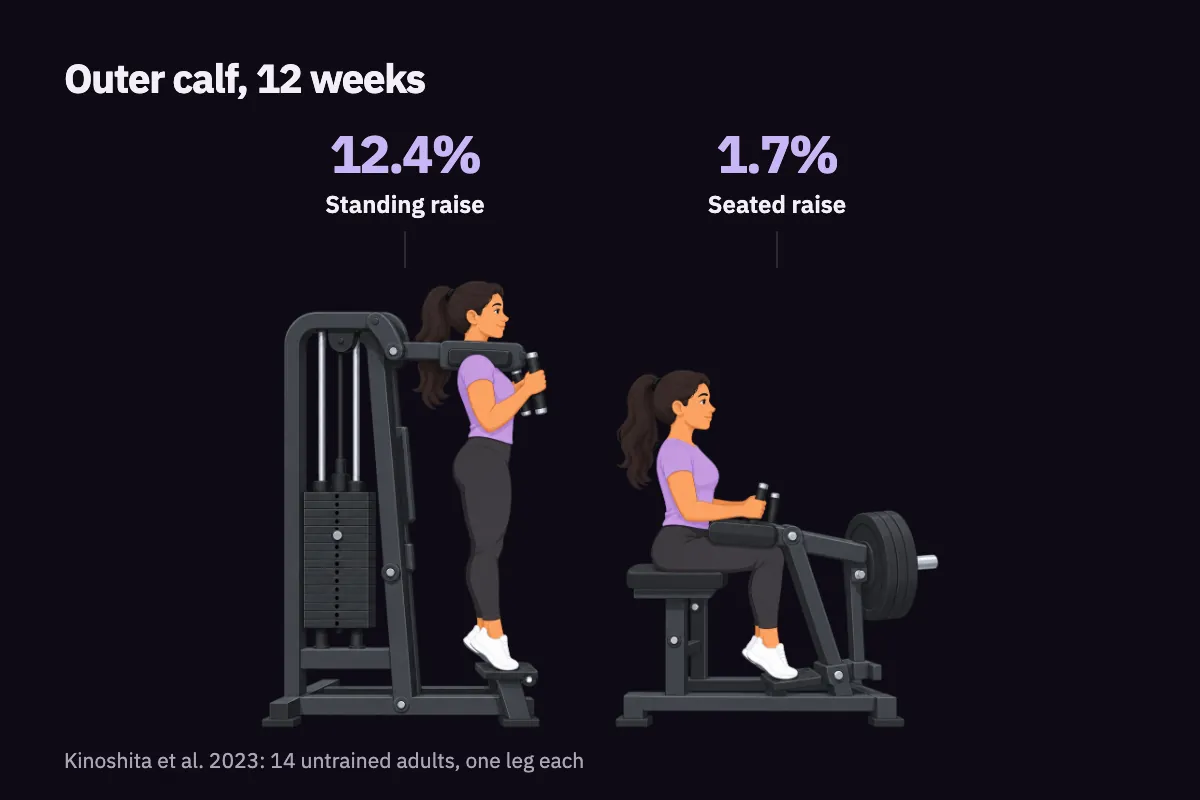
If you do one calf exercise, make it a straight-knee one such as a standing calf raise. In a 12-week MRI trial, standing raises grew the two gastrocnemius heads 12.4% and 9.2%, while seated raises grew them 1.7% and 0.6%. The deeper soleus grew about the same with both, around 2 to 3%. It is one small trial in untrained people, but the gap is large.
Why does the knee matter?
Your calf is mainly two muscles. The gastrocnemius, the visible upper calf, crosses both the knee and the ankle. Bending the knee slackens it. The soleus sits underneath and crosses only the ankle, so knee position doesn’t change its length.
So a seated raise, with the knee bent to 90 degrees, puts the gastrocnemius in a short position. A standing raise keeps it long.
What did the study find?
Kinoshita and colleagues trained 14 untrained adults, half women and half men, for 12 weeks. Each person did standing raises with one leg and seated raises with the other. Both did 5 sets of 10 reps twice a week, starting at 70% of one-rep max, with a 2-second lift and 2-second lowering.
| Muscle | Standing (knee straight) | Seated (knee bent 90°) |
|---|---|---|
| Lateral gastrocnemius | +12.4% | +1.7% (not significant) |
| Medial gastrocnemius | +9.2% | +0.6% (not significant) |
| Soleus | +2.1% | +2.9% (similar) |
| Whole calf (triceps surae) | +5.6% | +2.1% |
How much should you trust this?
Moderately. The anatomy explains the result well and the effect is large, which makes it easier to believe. But:
- It is small and untrained. 14 people, all new to this training.
- There was no control group. The authors argue that blinded analysis and low measurement error make the difference unlikely to be noise. The error was highest on the lateral gastrocnemius, the smallest muscle measured.
- It measured size only. No strength or jump data were collected.
- Seated raises aren’t useless. They still grew the soleus and the whole calf.
What should you do with it?
- Make a straight-knee raise your main calf exercise. A standing machine, leg press, hack squat or Smith machine raise all keep the knee straight, although only the standing version was tested.
- Add seated raises if you want extra soleus work. The soleus grew similarly with both in this trial, so they aren’t required for it.
- Control the bottom. Let the heel drop and don’t bounce. That keeps reps comparable from week to week, and our guide to lengthened partials covers what the research says about stretching.
- Stop if it hurts. Ease off for Achilles or calf pain and get qualified advice. This is general information, not medical advice.
How to log it
Log each raise separately, and use the same foot position and depth each time. Example log (invented numbers, not a recommendation):
| Week | Exercise | Sets |
|---|---|---|
| 1 | Standing calf raise | 60 kg × 12, 11, 10 at 1 RIR |
| 2 | Standing calf raise | 60 kg × 12, 12, 11 at 1 RIR |
| 3 | Standing calf raise | 65 kg × 11, 10, 10 at 1 RIR |
FitArchive has separate entries for standing, seated, leg press and other calf raises, stores weight, reps and RIR for every set, and counts them in your weekly sets per muscle. It’s free, with no account needed to start.