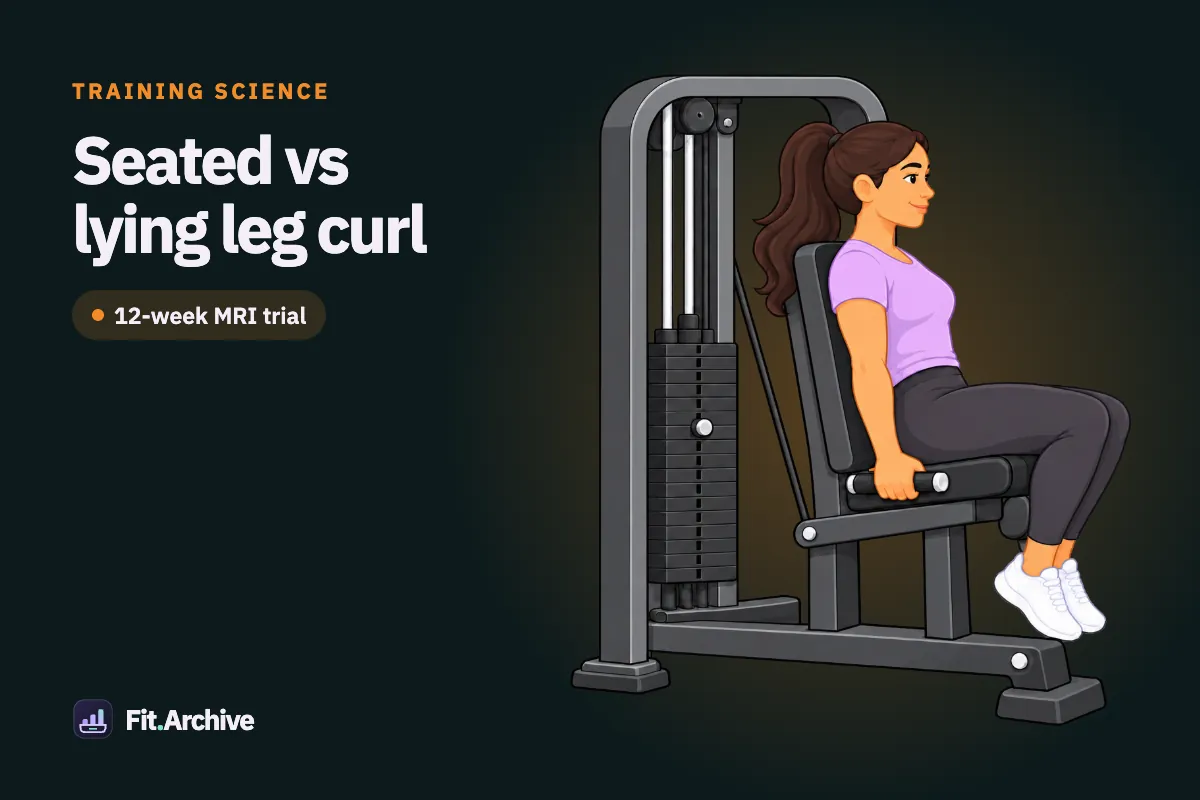
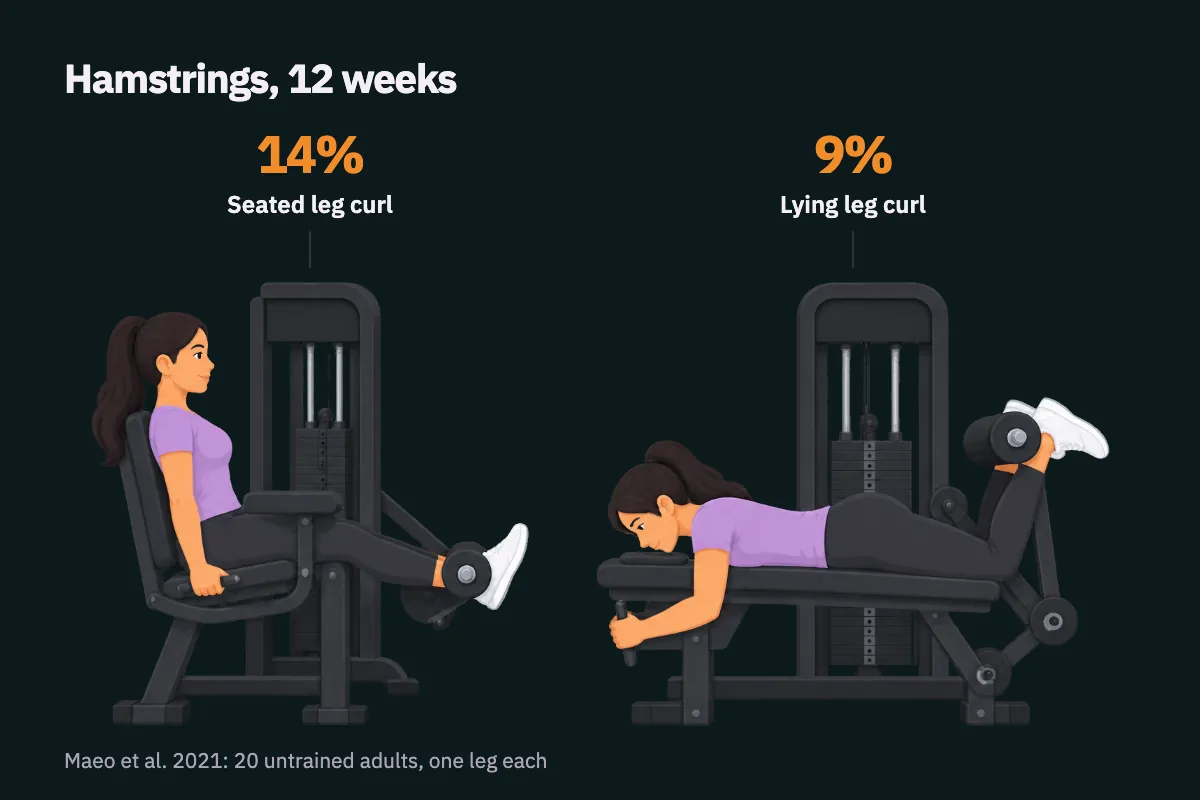
If you can only pick one, pick the seated leg curl. In a 12-week trial that measured muscle with MRI, seated curls grew the whole hamstrings about 14%, against about 9% for lying curls. That is one study in people new to lifting, so it is a sensible default rather than a rule. Lying curls still built muscle, and a curl you do consistently beats one you skip.
What is the difference between the two?
Both bend the knee against resistance. The difference is at the hip.
Three of the four hamstring muscles cross both the hip and the knee. Bending the hip stretches them. So when you sit, with the hip bent to about 90 degrees, those muscles work from a longer position than when you lie face down.
The fourth muscle, the short head of the biceps femoris, crosses only the knee. Hip position shouldn’t matter much for it, and that is what the trial found.
What did the study find?
Maeo and colleagues trained 20 young adults with no recent lifting experience for 12 weeks. Each person did seated curls with one leg and lying curls with the other, which removes differences between people. Both legs did 5 sets of 10 reps, twice a week, at 70% of their one-rep max.
| Muscle | Seated curl | Lying curl |
|---|---|---|
| Whole hamstrings | +14.1% | +9.3% |
| Biceps femoris, long head | About +14% | About +6.5% |
| Semitendinosus | About +24% | About +19% |
| Semimembranosus | About +8% | About +4% |
| Biceps femoris, short head | About +10% | About +9% (no real difference) |
How much should you trust this?
Moderately. The measurement is strong, as MRI measures muscle volume directly and each person acted as their own control. The limits are just as real:
- It is one trial. Nobody has repeated it in a large group, as far as we could find.
- The people were untrained. The gap may be smaller or larger in experienced lifters.
- It tested one way of training. The authors say they don’t know whether the result holds under other methods.
- The reason isn’t proven. Training at longer muscle lengths is the likely explanation, but the study didn’t establish how it works. Broader claims about stretch are weaker than this one result, as our guide to lengthened partials explains.
What should you do with it?
- Have both machines? Make the seated curl your main hamstring curl.
- Only have a lying curl? Use it. It grew the hamstrings 9% in the same trial, and that is a good result. Hard sets over time matter more than this choice.
- Curls don’t replace hip hinges. Romanian deadlifts train the same muscles through the hip, so most plans benefit from both.
- Do what your knees and back tolerate. If one machine feels bad, use the other. This article is general information, not medical advice.
How to log it
Log seated and lying curls as separate exercises. The loads aren’t comparable, so swapping between them under one name makes your progress look better or worse than it is.
Example log (invented numbers, not a recommendation):
| Week | Exercise | Sets |
|---|---|---|
| 1 | Seated leg curl | 40 kg × 10, 10, 9 at 1 RIR |
| 2 | Seated leg curl | 40 kg × 10, 10, 10 at 1 RIR |
| 3 | Seated leg curl | 42.5 kg × 10, 9, 9 at 1 RIR |
FitArchive has separate entries for each curl, stores weight, reps and RIR for every set, and counts them toward your weekly sets per muscle. It works free, with no account needed to start.