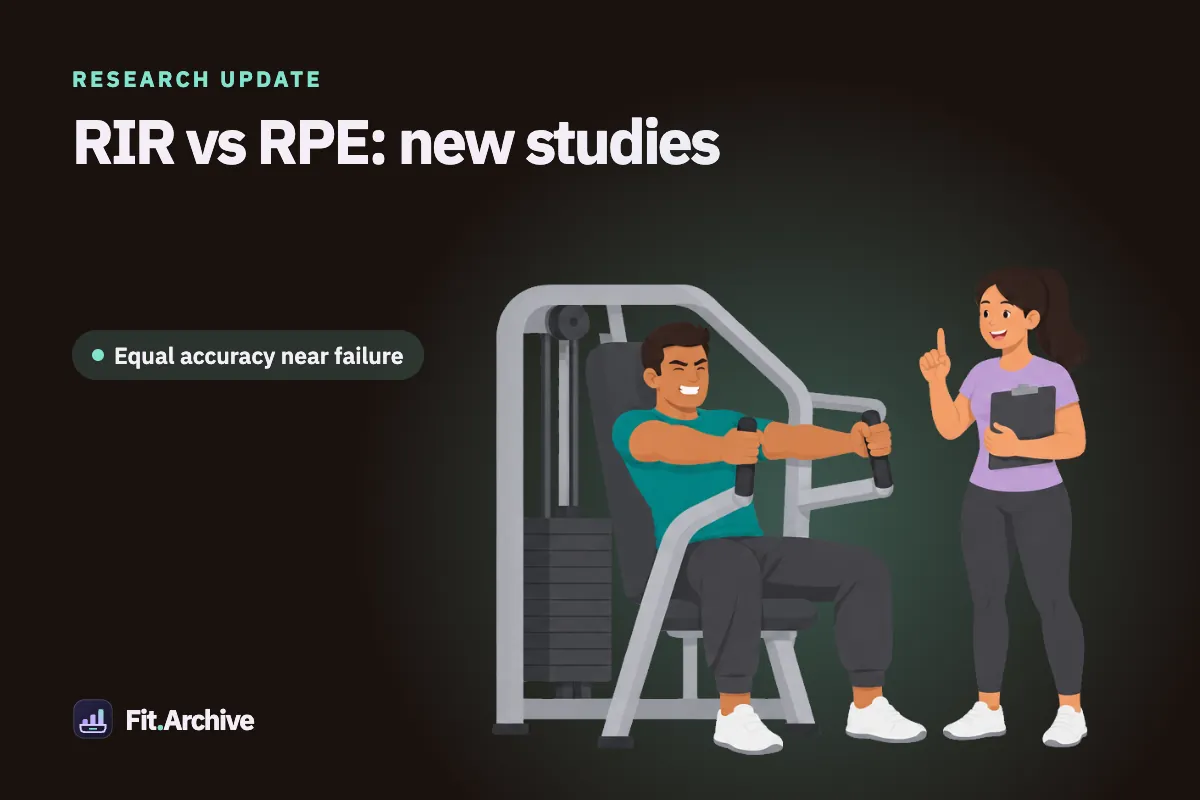
Is RIR or RPE better for judging how close you are to failure? In a new randomised crossover study of 32 people, neither was more accurate: when lifters called “2 reps left” (RIR) or “8 out of 10” (RPE) and then kept going to failure, the two methods missed by almost exactly the same amount. A second new study found that 45 minutes of a mentally tiring computer task before squatting cut the reps trained lifters completed. Pick the scale you like, use it the same way, and expect fewer reps on mentally draining days.
This is FitArchive’s research update. For each paper we say what was tested, what it found, how much weight to give it, and what, if anything, to change. We read the abstracts; where a detail was not reported there, we say so rather than guess. Both papers appeared online between 10 and 14 November 2026.
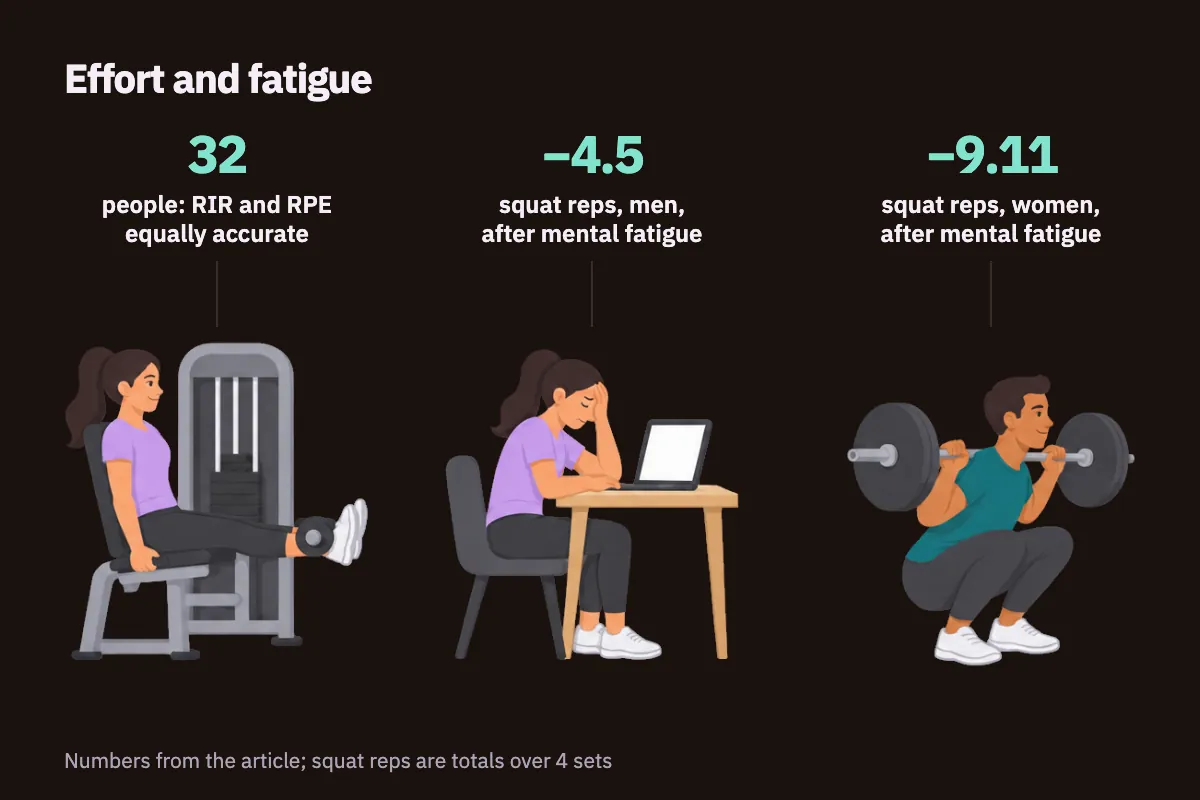
The exercises in the two studies, and the mentally tiring task that came before the squats.
First, what RIR and RPE mean here
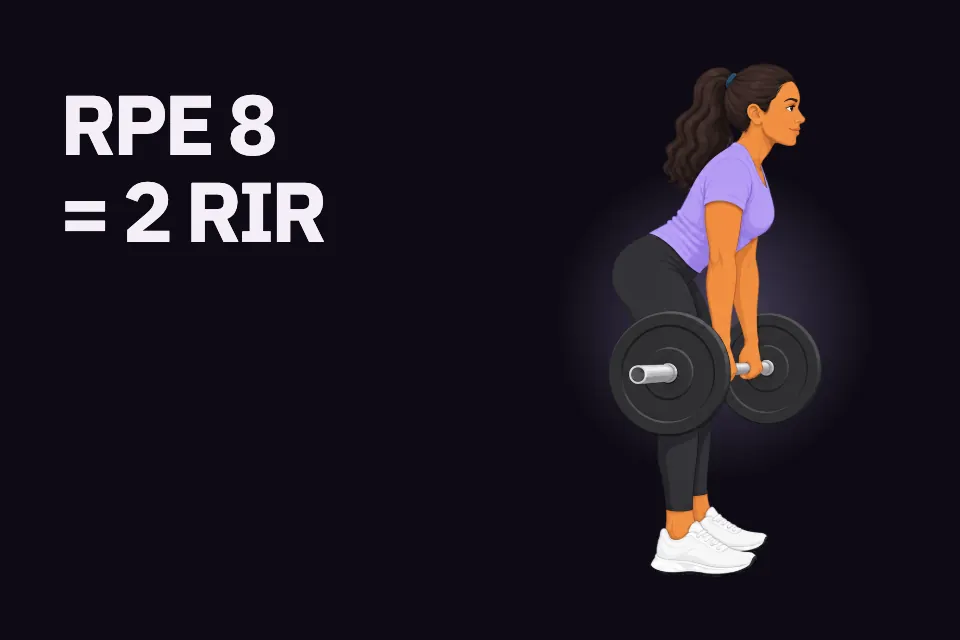
RIR (reps in reserve) is your estimate of how many more good reps you could have done. RPE (rating of perceived exertion) rates how hard the set felt. The lifting version of RPE runs from 1 to 10, where RPE 8 means about 2 reps left; our RPE vs RIR guide has the full chart. The new study used the Borg RPE scale, a general effort scale, not the reps-based lifting version. That matters for how far its result can be stretched.
Study 1: RIR vs RPE, which predicts failure better?
The paper. Holmes and colleagues, Journal of Sports Sciences, published online on 14 November 2026. Randomised crossover trial.
What they did. 32 people (19 trained, 13 untrained) did a machine chest press and a leg extension at 75% of their one-rep max. Each person came in twice: once using RIR and once using Borg RPE, in random order, with the exercise order also randomised. During each set they said out loud when they thought they had reached 2 RIR or RPE 8, then kept going until they could not complete another rep. Accuracy was the difference between the reps they actually had left and the reps they predicted.
What they found.
| Exercise | Difference in accuracy, RIR vs RPE | 95% confidence interval |
|---|---|---|
| Machine chest press | −0.03 reps | −0.50 to 0.44 |
| Leg extension | 0.16 reps | −0.39 to 0.71 |
- Neither difference was statistically significant, and neither confidence interval reaches a full rep in either direction.
- Training status did not change how the two methods compared.
- The abstract compares the two methods with each other; it does not report how far off people were overall, so we do not quote a number for that.
How much weight to give it: moderate. The crossover design, where each person used both methods, makes it a fair head-to-head comparison, and the result is tight. But it is one study of 32 people, on two machine exercises at one load, with one target (2 reps left). It does not tell you about free-weight squats or deadlifts, sets of 3 or 20 reps, or calls further from failure.
How it fits. It matches the existing picture that both scales are usable estimates with similar limits. A 2022 meta-analysis by Halperin and colleagues of 12 studies found people tend to underestimate how many reps they have left, by about one rep on average, and are more accurate closer to failure. The new study adds that switching between RIR and RPE does not fix that.
Study 2: does mental fatigue cost you reps?
The paper. Dello Stritto and colleagues, International Journal of Sports Physiology and Performance, published online on 10 November 2026. Randomised crossover design.
What they did. 19 resistance-trained people (10 men, 9 women) first had four familiarisation sessions. Then, in two sessions in random order, they did 8 sets of back squats: 4 sets rested, then 4 more after either a 45-minute mentally demanding attention test on a computer (the mental fatigue condition) or a 45-minute documentary (control). Each set stopped when bar speed dropped by a set amount (20% or 40% velocity loss), at 60% or 80% of one-rep max, and lifters pushed each rep up as fast as they could. Training volume was the total reps over the 4 sets.
What they found.
- After the mentally tiring task, training volume fell in both sexes: by 4.5 reps on average in men (standard deviation 4.6) and by 9.11 reps in women (standard deviation 7.5) across the 4 sets.
- After the documentary, volume did not change significantly.
- The speed of the first rep also fell only after the mental task: by 0.06 m/s in men and 0.03 m/s in women.
- The authors suggest the effect may differ between men and women, but the groups were 10 and 9 people.
How much weight to give it: low to moderate. It is randomised and well controlled, and the control task was the same length. But 19 people is small, the standard deviations are large (some people barely changed), and a 45-minute lab attention test is not the same as a long workday. Because sets ended on a velocity-loss cut-off rather than at failure, “fewer reps” here means bar speed dropped sooner. The abstract does not report how tired people felt, so we cannot say how much fatigue it took.
How it fits. It adds a resistance-training example, in trained men and women, to research on mental fatigue and performance. It does not show that mental fatigue changes muscle growth over weeks; it measured one session.
What this means if you lift
- Use whichever scale you prefer. In this study RIR and RPE were equally accurate, so the better choice is the one you will use the same way every set. If you count reps more easily, use RIR.
- Treat your number as an estimate. Expect to be off by about a rep, more so when many reps remain. Calls closer to failure tend to be more accurate.
- Expect fewer reps on mentally draining days. If you train after a long exam, or a hard day of screen work, a small drop in reps at the same effort is likely normal, not lost strength. Keep the effort target and accept the lower number, or move the session if you can.
- Write it down. A short note such as “after a long workday” next to a weaker session makes it easier to tell a bad day from a real stall.
| If you… | Based on these papers, consider… |
|---|---|
| Use RPE and wonder if RIR is better | Staying with RPE; this study found no accuracy difference |
| Struggle to judge reps left | Checking yourself now and then by finishing a safe set (machine or isolation) to failure |
| Train after mentally demanding work | Expecting a few fewer reps and noting it in your log |
| See one weak session | Looking at the trend over several weeks before changing your program |
How we judge new research
- Design first: randomised trials and meta-analyses over single observations. Both papers here are randomised crossover studies.
- Who was studied: a mix of trained and untrained adults (study 1) and trained adults (study 2), small samples in both.
- What was measured: one session each, so neither tells you about long-term strength or muscle growth.
- Fit with the existing evidence: both refine what was known rather than overturning it.
This article summarises research for general education. It is not medical advice or a personal training prescription. If you have a medical condition or an injury, talk to a doctor before training to failure.
Log effort for every set in FitArchive
FitArchive records weight, reps and reps in reserve for every set, plus a note for each workout, so you can see how close to failure you trained and spot the days when reps dropped. If you import a Strong or Hevy history, RPE values are converted to RIR using 10 − RPE. Our guide on how to log RIR walks through the routine, and the training to failure vs RIR guide covers how close to go. Try it with sample data in the demo.